



Find information about the Ministry of Education and Culture, organizational structure, and regulations.
Profile Information of Kementerian Pendidikan Dasar dan Menengah
Public Information of Kementerian Pendidikan Dasar dan Menengah
Find news, press releases, announcements, and official documentation from Kemendikdasmen
 Home
Profile
Home
Profile
Find information about the Ministry of Education and Culture, organizational structure, and regulations.
About Us
Profile Information of Kementerian Pendidikan Dasar dan Menengah
Profiles of Officials
Public Information
Public Information of Kementerian Pendidikan Dasar dan Menengah
LHKPN Report
Laporan Moch. Abduh
Laporan LHKPN Fajar Riza Ul Haq
Laporan LHKPN Atip Latipulhayat
Laporan LHKPN Suharti
Laporan Abdul Mu'ti
Laporan Faisal Syahrul
Laporan Nunuk Suryani
Laporan Gogot Suharwoto
Laporan Tatang Muttaqin
Laporan Toni Toharudin
Laporan Hafidz Muksin
Laporan Biyanto
Laporan Mariman Darto
Laporan Didik Suhardi
Laporan Muhammad Muchlas Rowi
Laporan Ma'ruf
Laporan Rita Pranawati
Publication
Find news, press releases, announcements, and official documentation from Kemendikdasmen
PPID
The Ministry of Elementary and Secondary Education, through SEAMEO RECFON, Promotes Evidence-Based Nutrition Policies for Students


Published on: 10 September 2026
Share:
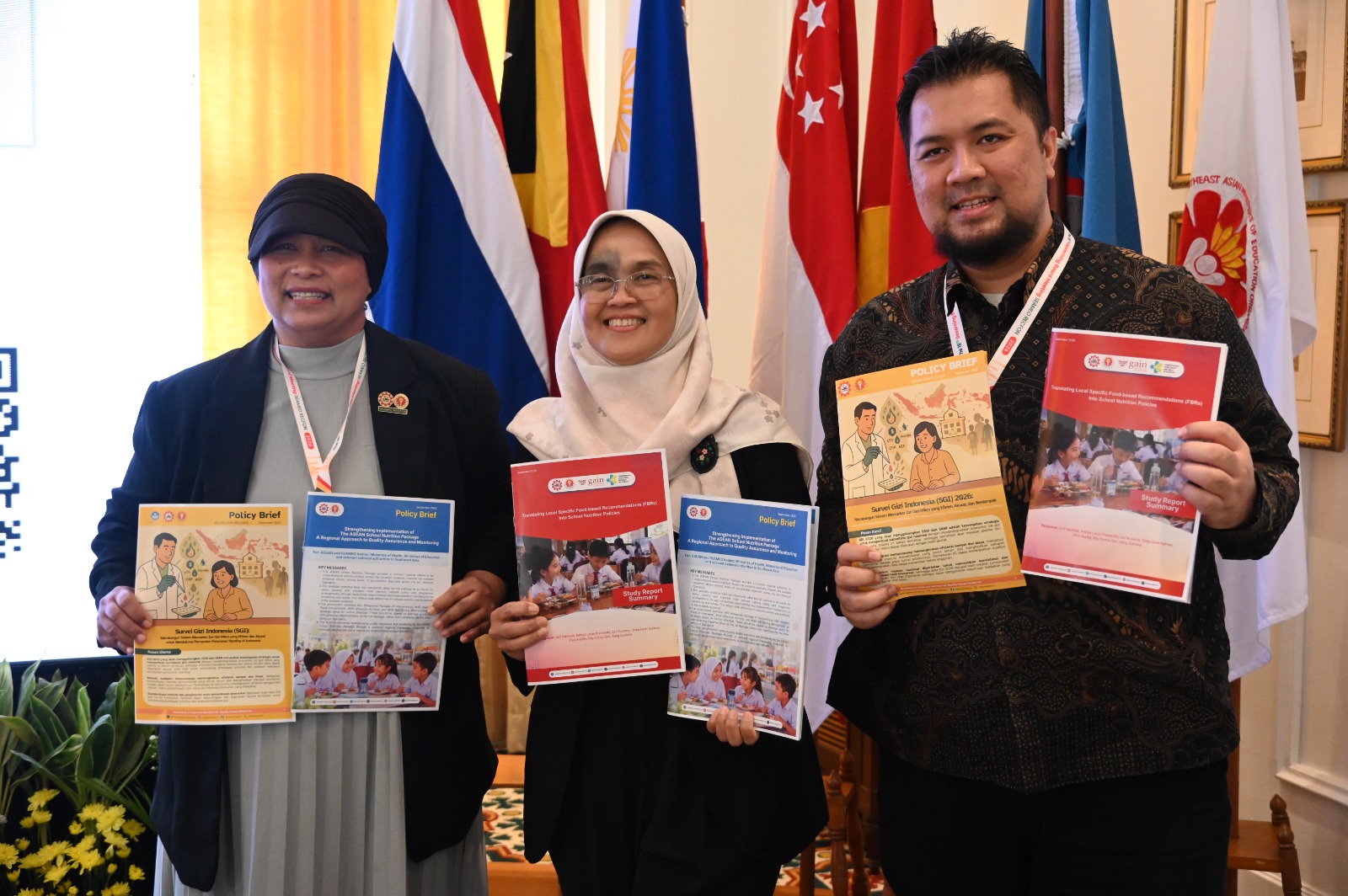
Jakarta, September 10, 2026 – The Southeast Asian Ministers of Education Organization Regional Centre for Food and Nutrition (SEAMEO RECFON), one of seven regional centres under the coordination of the Ministry of Primary and Secondary Education (Kemendikdasmen), held a Press Conference for the 16th Governing Board Meeting (GBM) in Jakarta on Wednesday (September 9). The annual meeting, attended by 11 members of the Board of Trustees representing SEAMEO member countries, also launched three evidence-based policy briefs to support the health, nutrition, and quality of student learning in Indonesia and the Southeast Asian region. At the opening ceremony of the 16th GBM, the Secretary General of the Ministry of Primary and Secondary Education, Suharti, emphasized that ensuring quality nutrition is a crucial foundation for children's educational success. "Good nutrition is a condition that enables optimal learning. Students may study in excellent schools, with professional teachers, and an appropriate curriculum, but if they come to class hungry or malnourished, optimal learning will be difficult," Suharti emphasized. Suharti also appreciated SEAMEO RECFON's role in supporting the 2024 Indonesian Nutritional Status Survey (SSGI), which recorded a decline in the stunting rate among toddlers from 21.5 percent in 2023 to 19.8 percent. She emphasized the Free Nutritional Meal Program (MBG), which is targeted to reach around 60 million students by 2027, as a significant opportunity to integrate nutrition education, food security, and healthy lifestyle habits. Furthermore, SEAMEO RECFON Director, Rini Sekartini, presented the first policy brief on strengthening the micronutrient biomarker system in SSGI 2026 through multiplex immunoassay technology and increasing laboratory capacity to improve data accuracy and efficiency in evaluating the acceleration of stunting reduction. Rini explained, "The launch of this policy brief is a concrete manifestation of our mandate to bridge science, policy, and practice. Strengthening micronutrient biomarkers is useful for supporting the determination of priorities and evaluation of policies to accelerate stunting reduction in Indonesia more effectively and efficiently." Meanwhile, SEAMEO RECFON Deputy Program Director Brian Sri Prahastuti added the importance of comprehensively detecting the root causes of anemia in students. "Anemia is a concern for us because it is directly related to students' ability to absorb lessons due to reduced oxygen supply to brain cells. With a single, more comprehensive blood test, we can provide much more targeted intervention recommendations," Brian said. The second policy brief addresses the Implementation of Local Food-Based Balanced Nutrition Guidelines (PGS-PL) in School Nutrition Policy, based on research on 4,219 students aged 7–18 in 12 districts/cities across 12 provinces using WHO Optifood. This study identified gaps in micronutrient intake among students, with gaps in folate intake reaching 100 percent, calcium 78 percent, and vitamin A 25 percent, followed by vitamin C and zinc. The research results were translated into a seven-day menu cycle based on local food and culinary delights as a reference for the central government, regional governments, Nutrition Fulfillment Service Units (SPPG), and schools in developing local menus to support the MBG. The research was conducted before the MBG was implemented. The findings illustrate the variation in micronutrient issues across regions and the importance of adapting menus to local food potential. In addition, the third policy brief focuses on strengthening the implementation of school nutrition program packages at the ASEAN level through quality assurance and regional monitoring. "Through the flagship program Nutrition for Achievement or Nutrition Goes to School , we have accompanied partner countries such as Laos and Cambodia. In Indonesia, this step is in line with the strengthening of School Health Efforts (UKS) and the Seven Habits of Great Indonesian Children (7 KAIH) movement at the Ministry of Education and Culture, especially healthy and nutritious eating habits," said Deputy Director of Administration of SEAMEO RECFON, M. Dzaky F. Surapranata. The launch of the three policy briefs further solidifies SEAMEO RECFON's role as a Center of Excellence and regional knowledge hub in the field of food and nutrition in Southeast Asia, while also bridging science, policy, and practice. The Ministry of Elementary and Secondary Education, through SEAMEO RECFON, is committed to strengthening nutrition policies, the use of local foods, and education in school environments to create a generation of healthy, intelligent, and competitive Indonesian and Southeast Asian students.*** (Authors: Rany, Zahra / Editor: Uly / Photographer: Rahman)


Bureau of Communication and Public Relations
Secretariat General
Ministry of Primary and Secondary Education
Website: kemendikdasmen.go.id
X: x.com/Kemdikdasmen
Instagram: instagram.com/kemendikdasmen
Facebook: facebook.com/kemendikdasmen
YouTube: Ministry of Education and Culture
Questions and Complaints: ult.kemendikdasmen.go.id
Press Release from the Ministry of Primary and Secondary Education: kemendikdasmen.go.id/pencarian/siaran-pers
#QualityEducationforAll
#MinistryOfEducationAndEducationFriendly
Source: Siaran Pers Kementerian Pendidikan Dasar dan Menengah Nomor: 801/sipers/A6/IX/2026
Writer: Rany Larasari
Editor: Denty Anugrahmawaty
 Dinas Pendidikan
Ruang Murid
Ruang Pemerintah
Ruang Mitra
Ruang Publik
Sekjen
Murid Dikdasmen
Mitra Dikdasmen
Orang Tua
Penguatan Pendidikan Unggul, Literasi, Numerasi dan Sains Teknologi
Dinas Pendidikan
Ruang Murid
Ruang Pemerintah
Ruang Mitra
Ruang Publik
Sekjen
Murid Dikdasmen
Mitra Dikdasmen
Orang Tua
Penguatan Pendidikan Unggul, Literasi, Numerasi dan Sains Teknologi