



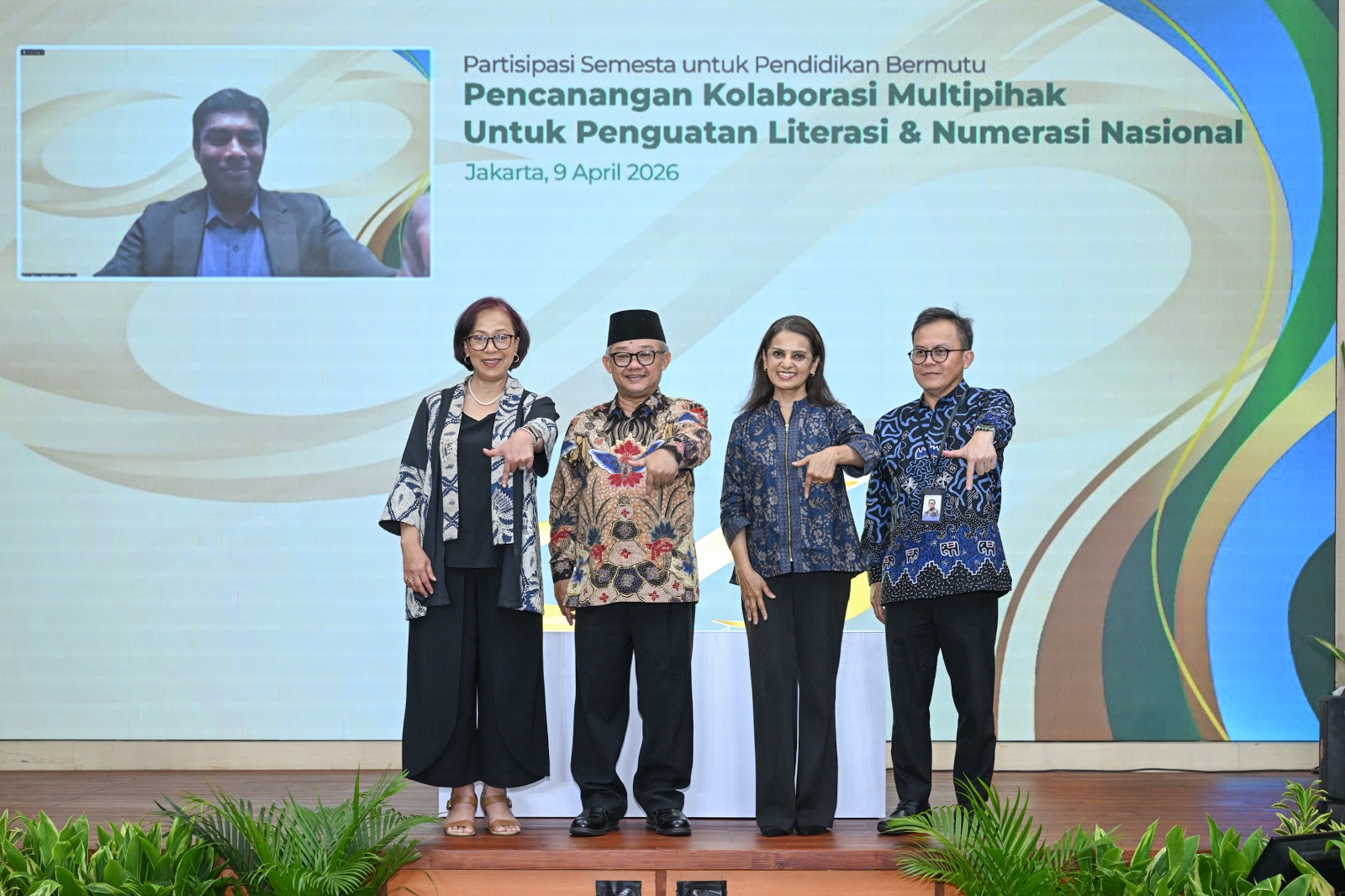
Jakarta, April 9, 2026 – The challenges of literacy and numeracy, which remain fundamental issues in Indonesian education, have prompted the Ministry of Primary and Secondary Education (Kemendikdasmen) through the Primary and Secondary Education Policy Agency (BKPDM), together with the Tanoto Foundation, the Gates Foundation, and UNICEF, to initiate Universal Participation for Quality Education: “Multi-stakeholder Collaboration for Improving National Literacy and Numeracy.” This program is also supported by local governments from a number of districts/cities as part of a joint effort to improve the quality of education in Indonesia.
The collaboration is part of an effort to strengthen the implementation of the National Literacy Movement (GLN) and the National Numeracy Movement (GNN) at the educational unit level, particularly through improving the quality of learning in early elementary school grades, strengthening teacher capacity, and utilizing diagnostic assessment data to support student-centered learning.
Furthermore, the collaboration is planned to last until 2029, targeting early elementary school students. It focuses on strengthening basic skills in the early elementary school years, which serve as a crucial foundation for subsequent mastery of science. Reading, writing, and arithmetic skills not only form the basis for academics but also play a role in building students' self-confidence and thinking skills.

In his remarks, the Minister of Primary and Secondary Education (Mendikdasmen), Abdul Mu'ti, emphasized that various challenges such as learning loss, learning poverty, and suboptimal literacy and numeracy achievements must be the driving force for continuous improvement. "The various problems we face are not the end, but rather motivation to work better. We must ensure that all Indonesian children receive quality and equitable education services," Minister Muti said in Jakarta (April 9).
Meanwhile, Margaretha Ari Widowati, Head of the Learning Environment Department at the Tanoto Foundation, emphasized that literacy and numeracy are the main foundations in determining the success of children's learning. She said that strengthening these two aspects cannot be done by one party alone, but requires complementary multi-stakeholder collaboration between the government, development partners, and local governments. "For the Tanoto Foundation, literacy and numeracy are not just academic skills, but the foundation that determines whether a child can continue to learn, think critically, and develop in the future," she said.

Margaretha emphasized the urgency of strengthening literacy and numeracy from an early age through a structured, data-driven approach that will focus on strengthening classroom learning practices and utilizing data to ensure targeted interventions for students. "We believe that progress cannot be achieved by one party alone. Strong collaboration, supported by effective, data-driven learning practices, will drive sustainable improvements in the quality of learning," she emphasized.
Furthermore, UNICEF Indonesia Country Representative, Maniza Zaman, emphasized the importance of fulfilling every child's right to a quality education through strong multi-stakeholder collaboration. She stated that joint efforts between the government, development partners, and education stakeholders are a crucial investment for the future of Indonesia's young generation. "Every child has the right to a quality education. The collective efforts we are making today are a crucial investment in ensuring children can achieve their future," she said.

Maniza highlighted the challenges of the learning crisis still faced globally and nationally, including suboptimal literacy and numeracy outcomes. She also expressed appreciation for Indonesia's progress in access to basic education, and emphasized that strengthening learning quality remains a priority. In this regard, UNICEF reaffirmed its commitment to continuing to support the Indonesian government through innovative and evidence-based approaches.
"The world is currently facing a learning crisis, fueled by increasing global uncertainty and a changing landscape of multilateral cooperation. Nearly 7 out of 10 children worldwide are experiencing a learning crisis. Many children are unable to read and understand simple texts by the age of 10, requiring collective efforts to address this," he stressed.

Similarly, Satish Menon, Senior Program Officer for Global Education at Gates Foundation India, emphasized that multi-stakeholder collaboration is key to sustainably strengthening the foundations of literacy and numeracy in Indonesia. This initiative will support at least 45,000 students with a measurable approach based on global best practices. "This initiative demonstrates that strong partnerships can drive real change. With government leadership, partner support, and effective data utilization, Indonesia has a significant opportunity to create a sustainable and meaningful educational impact for the future of children," he said.
In its implementation, there are three main focuses that will be developed. First, strengthening competencies through a learning approach that emphasizes basic thinking skills, including text comprehension and logical problem-solving. Second, developing reading habits by increasing reading engagement and providing engaging and easily accessible reading materials. Third, strengthening a numeracy learning culture that emphasizes logical understanding, not just memorizing numbers.
Through strong synergy between the central and regional governments, and development partners, the Ministry of Education and Culture is optimistic that it can accelerate improvements in the quality of national education while simultaneously realizing a superior generation of Indonesians towards the vision of Golden Indonesia 2045.

Bureau of Communication and Public Relations
Secretariat General
Ministry of Primary and Secondary Education
Website: kemendikdasmen.go.id
X: x.com/Kemdikdasmen
Instagram: instagram.com/kemendikdasmen
Facebook: facebook.com/kemendikdasmen
YouTube: Ministry of Education and Culture
Questions and Complaints: ult.kemendikdasmen.go.id
Press Release from the Ministry of Primary and Secondary Education: kemendikdasmen.go.id/pencarian/siaran-pers
#QualityEducationforAll
#MinistryofEducationAndEducationFriendly