



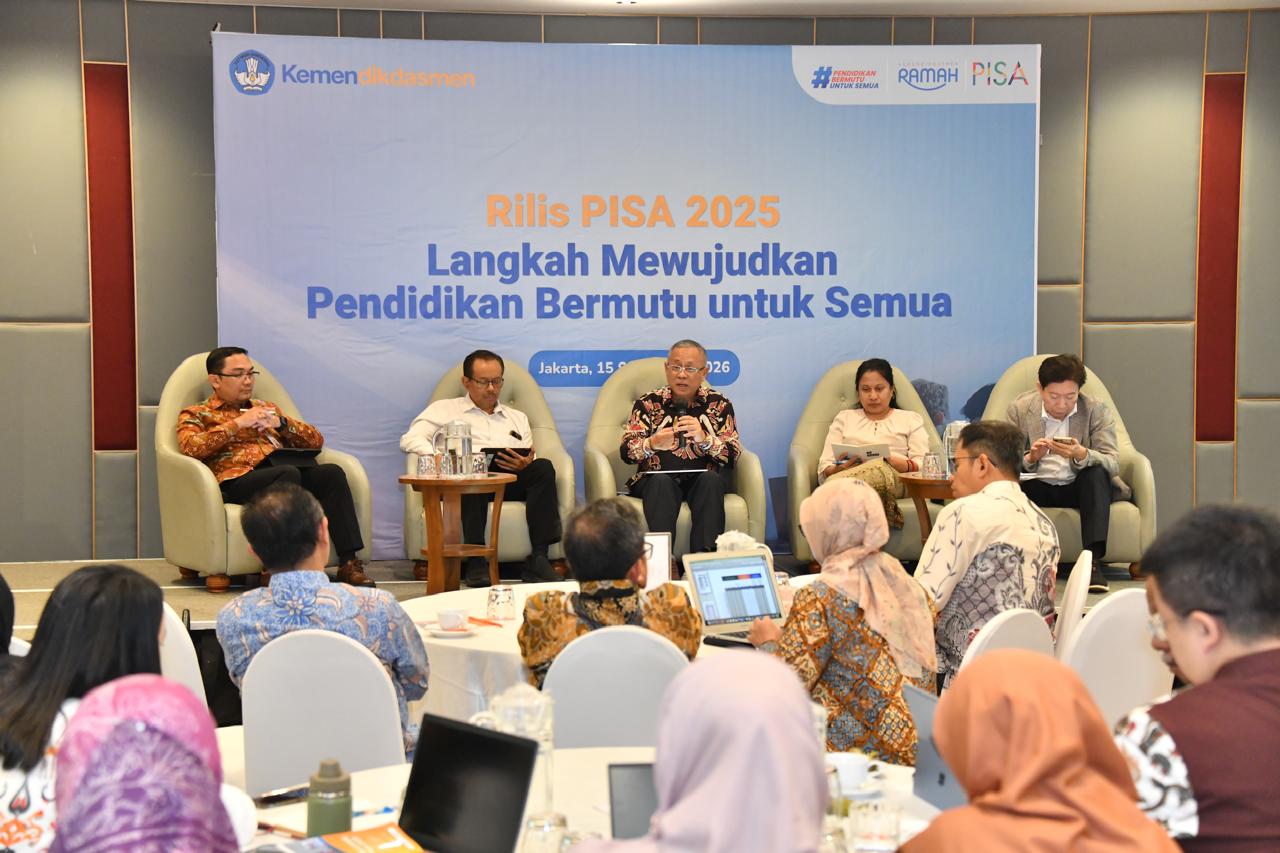
Jakarta, September 17, 2026 — The results of the 2025 PISA test not only show the academic achievements of Indonesian students but also reveal positive potential that can be developed in learning. As many as 80 percent of Indonesian students expressed curiosity about many things, higher than the average of 73 percent in member countries of the Organization for Economic Co-operation and Development (OECD). This potential was one of the topics discussed at the 2025 Indonesian PISA Results Seminar held by the Center for Education Assessment, the Primary and Secondary Education Policy Agency (BKPDM), and the Ministry of Primary and Secondary Education (Kemendikdasmen) in Jakarta on Tuesday (September 15).
The Head of the National Development Planning Agency (BKPDM), Toni Toharudin, stated that the increase in reading and science skills is commendable, while the decline in mathematics is a concern that requires follow-up through appropriate policies. "By 2025, we need to position this not merely as a report on achievements, but as a basis for improving and accelerating the development of our education system," Toni said. One of the policy directions conveyed is improving the quality of classroom learning, particularly the ability to reason, solve problems, and apply knowledge in real-world contexts.

The OECD's Director of Education and Skills, Andreas Schleicher, stated that strong curiosity was one of the positive findings of the PISA 2025 assessment in Indonesia. He stated that Indonesia is among the countries with a high level of student curiosity. In the OECD index, the average OECD member country scores 5, while Indonesia scores 9. Indonesia also demonstrates relatively good self-directed learning skills, namely the ability to plan and manage one's own learning.

In addition to curiosity, 74 percent of Indonesian students reported trying harder when faced with challenging work, compared to the OECD average of 60 percent. Compared to 2022, the proportion of students reporting being curious about many things increased by 7.3 percentage points, while those reporting trying harder when faced with challenges increased by 7.2 percentage points.
Responding to this, Ali Saukah, a representative from the National Education Council, saw this curiosity as a potential that needs to be developed through the learning process. He called it "social capital" that can be a source of optimism. "That (curiosity) is social capital that I think is very good for making us optimistic," Ali said.
How this potential develops into thinking skills is illustrated by the example provided by Edy Tri Baskoro, Professor at the Bandung Institute of Technology. He believes that mathematics learning should provide students with the space to think, reason, try various solutions, present reasons, and reflect. Learning should not focus on covering a large amount of material, but rather provide space for a deeper understanding of a topic.
One idea is " one reasoning problem every day, " which is implemented at every level of education. With approximately 200 days of learning per year, over nine years, this practice can provide students with approximately 1,800 reasoning experiences.
This view also places teachers as a crucial part in creating learning that allows students to think. Diana Rochintaniawati from the Indonesian University of Education said that the strengths of Indonesian teachers, who are considered helpful, need to be directed towards inquiry- based learning. PISA 2025 recorded that 82 percent of Indonesian students assessed that teachers showed attention to their learning in most science lessons, while 85 percent said teachers continued teaching until they understood the material. Through inquiry , students are encouraged to discover, test, reflect, and present arguments based on evidence. "So invite students to inquiry ," said Diana.
Sri Rezki Widuri from INOVASI stated that Deep Learning can take the learning process beyond the understanding stage. She explained that this approach encourages students to apply, evaluate, reflect, and transfer knowledge or skills to new contexts. In literacy, reading skills are also directed towards reading to learn , so reading goes hand in hand with thinking skills.
This process also requires family support. Murni Leo of the Tanoto Foundation said that a 2025 survey conducted by the Tanoto Foundation and J-PAL of 8,060 parents in 17 districts/cities across five provinces showed that 92 percent of parents considered involvement in their children's education important, and 68 percent helped their children with homework. She added that parents spend an average of 104 minutes per day supporting their children's education. "So, our opportunity lies in how we utilize those 104 minutes to improve," Murni said.

These findings demonstrate that students' curiosity is a potential that can be developed into deeper learning abilities. Through a Deep Learning approach, this curiosity can be given space to grow into habits of asking questions, reasoning, solving problems, reflecting on experiences, and applying that knowledge in new situations.*** (Author: Uly/Documentation: BKPDM Team)
Bureau of Communication and Public Relations
Secretariat General
Ministry of Primary and Secondary Education
Website: kemendikdasmen.go.id
X: x.com/Kemdikdasmen
Instagram: instagram.com/kemendikdasmen
Facebook: facebook.com/kemendikdasmen
YouTube: Ministry of Education and Culture
Questions and Complaints: ult.kemendikdasmen.go.id
Press Release from the Ministry of Primary and Secondary Education: kemendikdasmen.go.id/pencarian/siaran-pers
#QualityEducationforAll
#MinistryofEducationAndEducationFriendly