



Jakarta, September 18, 2026 – Rapid technological change demands that teachers continue to learn and develop their competencies. The growing presence of artificial intelligence, which is becoming more relevant to students' lives, also encourages learning to go beyond simply delivering material, but also to develop thinking skills, problem-solving skills, and connect knowledge to real life.
To address these challenges, the Ministry of Primary and Secondary Education, through the Directorate General of Teachers and Education Personnel (Ditjen GTK), is expanding access to teacher competency development through Independent Training and Blended In-Depth Learning and Coding and Artificial Intelligence Training (PMKKA).
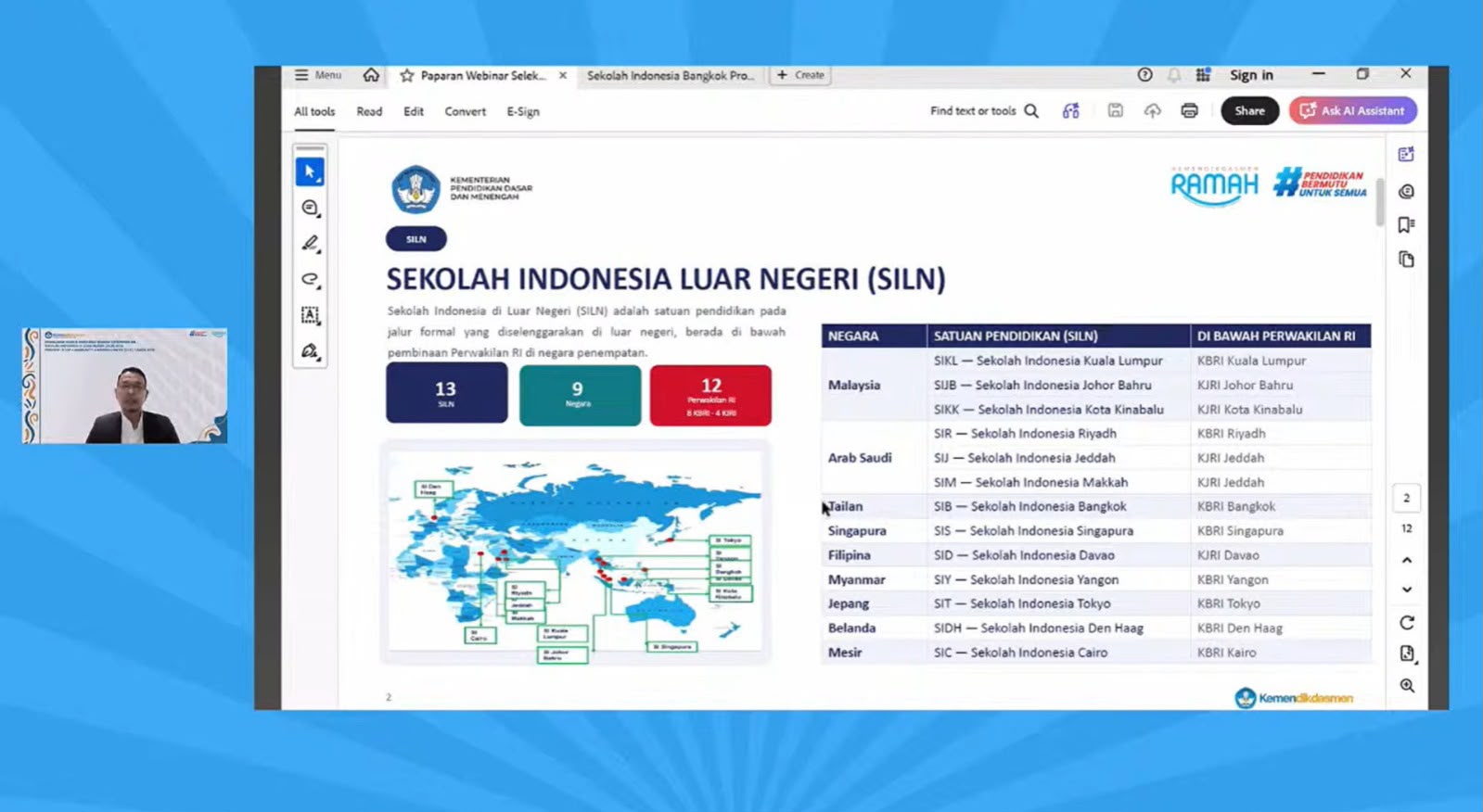
The program was socialized through a webinar attended by high school, vocational school, and special needs school teachers, school principals, supervisors, PMKKA officers at BBGTK, BGTK, and KGTK, as well as program managers at provincial and district/city education offices.
The Director General of Teachers and Education Personnel (Dirjen GTK) of the Ministry of Primary and Secondary Education, Nunuk Suryani, when opening the webinar emphasized that PMKKA is part of an effort to strengthen teacher competency so that they are able to provide learning that is more in-depth, meaningful, and relevant to current developments.

"Through PMKKA, we want to encourage teachers not only to master the material but also to be able to translate it into real and meaningful learning practices in the classroom," said Nunuk.
He hopes this outreach will not remain a ceremonial activity, but rather serve as a starting point for teachers to access, understand, and implement PMKKA in their respective schools. He also hopes the insights and best practices gained can be shared through special education teacher forums, working groups, and other learning communities so that the program's benefits reach more teachers and educational units.
Director of Secondary Education and Special Education Teachers, Arif Jamali, in his report stated that Independent Training and Blended Training are one of the efforts to provide broader learning opportunities for teachers, especially for those who have not been reached by face-to-face training.

"No matter how good a program is, it needs to be understood by those who will implement it. Therefore, this outreach is crucial so that participants understand the objectives, flow, mechanisms, and support available during the training," said Arif.
He believes that the process of developing teacher competency doesn't stop with training completion, but needs to continue with changes in classroom learning practices. Therefore, he hopes that support from the education office, educational units, technical implementation units (UPT), and the teacher community will encourage participants to complete the training and apply their learning outcomes.
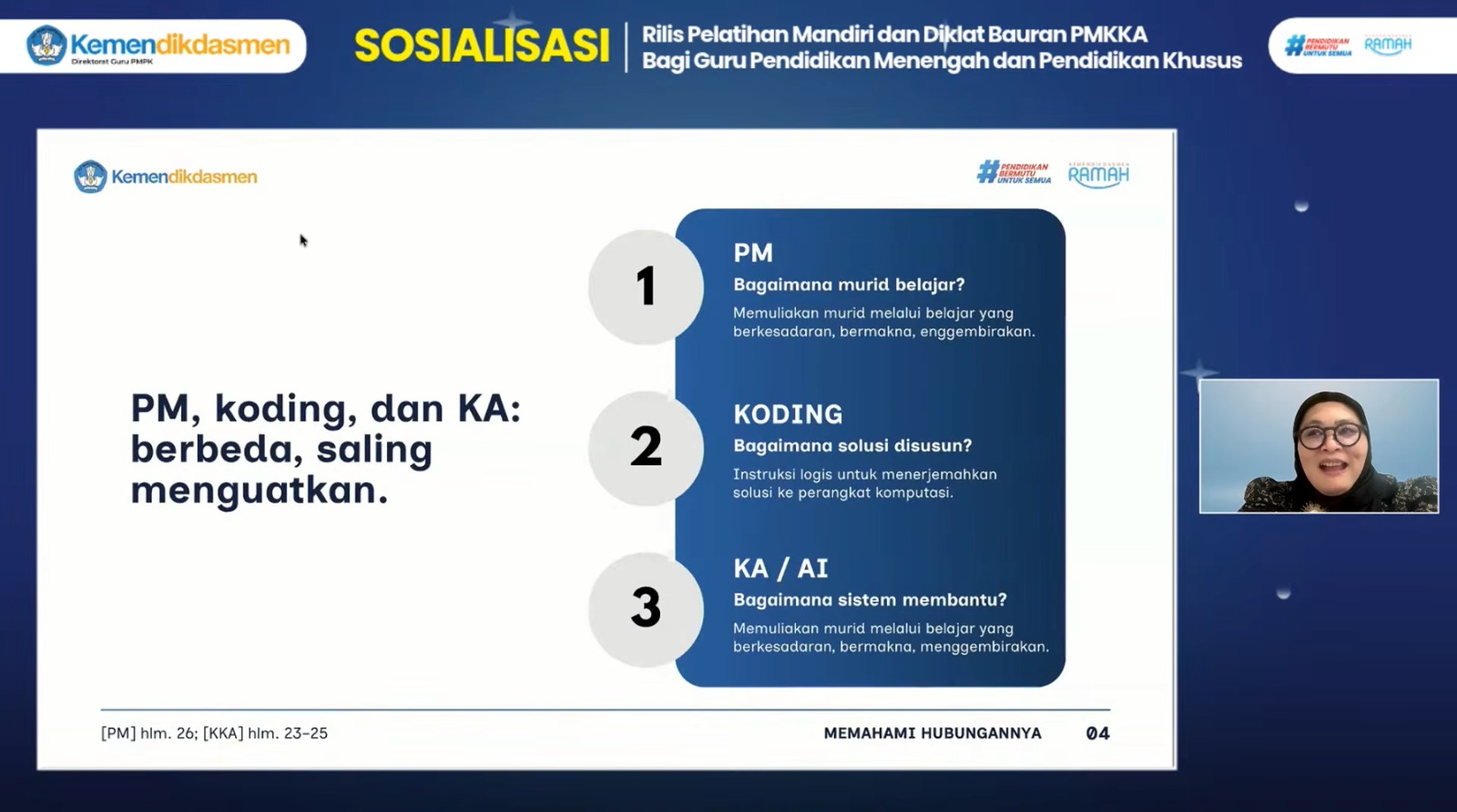
The strengthening of the substance of PMKKA was then conveyed by the Special Staff of the Minister of Primary and Secondary Education for STEM and Teacher Competence, Maila Dania Husni Rahiem, with the message "Students Understand More, Teachers Are Empowered."

Maila explained that Deep Learning is not just a change in teaching methods, but an effort to provide learning experiences that make students truly understand what is being learned, are able to connect it to the context of life, and use knowledge to think and solve problems.
Deep Learning has three main characteristics: awareness, meaning, and enjoyment. With this approach, students are expected to not only memorize information but also understand the meaning of the learning and be able to apply it to their lives.
In this context, teachers play a crucial role in designing learning that meets students' needs. Teachers who continue to learn will gain greater skills and confidence in delivering relevant learning, including leveraging technological advances.
"We want students to understand better and teachers to be more empowered. The various approaches and technologies used in learning should ultimately provide a better learning experience for students," Maila explained.
He added that coding can help develop computational, logical, systematic, and creative thinking. Meanwhile, artificial intelligence can be used to enrich learning, while still fostering critical thinking skills, ethics, and responsibility in using technology.
"The easier technology becomes to use, the more important critical thinking skills become. Teachers still have a crucial role to play in guiding students in using technology wisely and responsibly," Maila continued.
After strengthening the substance, Yoki Ariyana from BBGTK West Java explained the technical flow of Independent Training and PMKKA Mixed Training.

Independent Training provides a flexible learning environment for all teachers through the Education House. The process begins with studying various topics and modules, followed by comprehension exercises and writing reflective stories after learning.
Next, participants take a post - test to measure understanding, then receive information and recommendations for re-studying material that still needs to be strengthened.
Meanwhile, the Blended Training is aimed at instructors of Deep Learning, Coding, and Artificial Intelligence (AI) in 2025, as well as participants who have completed the Independent Training. The learning process combines independent and collaborative learning between participants, with outcomes aimed at mastering knowledge and skills at an advanced to advanced level.
Yoki also explained the stages that participants need to follow, starting from accessing the program, studying the material, participating in learning activities, completing assignments or assessments, and ensuring that the entire training series is fulfilled.
"Participants need to follow each step that has been prepared so that the learning process doesn't stop at reading the material, but truly provides a complete learning experience," said Yoki.
Through this expanded access, the Ministry of Education and Culture hopes that more high school, vocational school, and special needs (SLB) teachers will have the opportunity to continue developing their competencies and bring their learning outcomes into the classroom.
Because, when teachers continue to learn, they become more empowered. When teachers are empowered, students have the opportunity to learn better, more meaningfully, and be better prepared for the future.*** (Author & Documentation: GTKPG Directorate General Team/Editor: Stephanie)
Bureau of Communication and Public Relations
Secretariat General
Ministry of Primary and Secondary Education
Website: kemendikdasmen.go.id
X: x.com/Kemdikdasmen
Instagram: instagram.com/kemendikdasmen
Facebook: facebook.com/kemendikdasmen
YouTube: Ministry of Education and Culture
Questions and Complaints: ult.kemendikdasmen.go.id
Press Release from the Ministry of Primary and Secondary Education: kemendikdasmen.go.id/pencarian/siaran-pers
#QualityEducationforAll
#MinistryOfEducationAndEducationFriendly