



Jakarta, Ministry of Education and Culture – The 2025 International Mother Language Day (IMT) commemoration is a crucial opportunity for Indonesia to continue its efforts to revitalize regional languages as part of its inclusive education and cultural preservation strategy. In line with the theme "Regional Languages Support Quality Education for All," the government affirms its commitment to strengthening the role of mother tongues in the national education system.
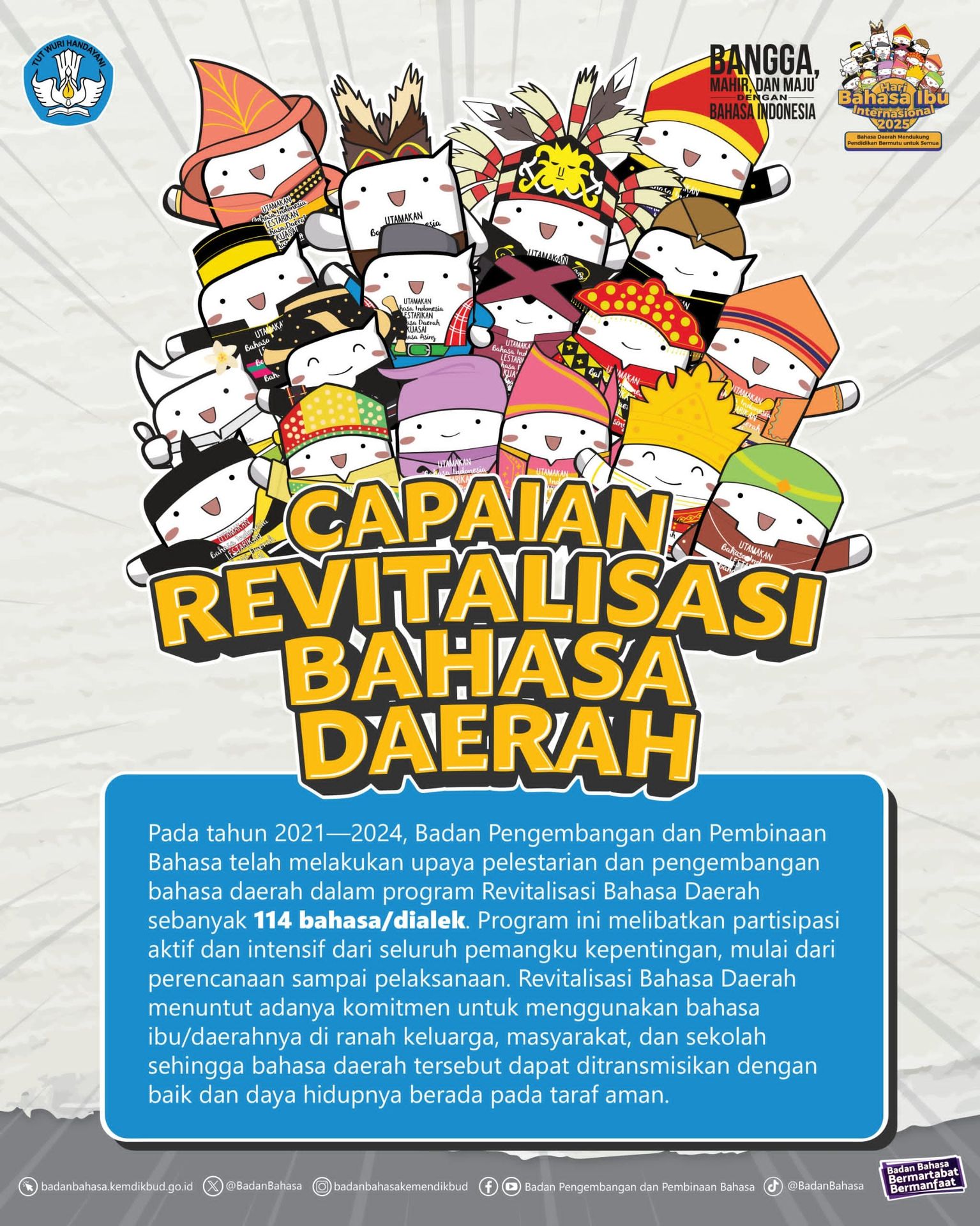
Between 2021 and 2024, the Ministry of Primary and Secondary Education (Kemendikdasmen), through the Language Development and Fostering Agency (Badan Bahasa), implemented the Regional Language Revitalization (RBD) program, reaching 38 provinces with 114 regional languages. This program targets young people to maintain their regional languages through learning in schools and active use within families and communities. Despite positive progress, challenges in funding, cross-sector coordination, and digitalization remain key focuses in developing a revitalization strategy for the next five years.
As a follow-up, the government has developed a roadmap for Regional Language Revitalization 2025–2029, emphasizing the implementation of mother tongue-based education, the use of digital technology, and increased synergy with regional governments and local communities. The multilingual curriculum will be expanded to regions with significant regional language populations, with the goal of increasing learning effectiveness while protecting endangered languages. In line with technological developments, digital approaches will be optimized through social media and podcasts to reach the younger generation more effectively.
The government is also emphasizing budget efficiency in program implementation in 2025. In accordance with Presidential Regulation No. 1 of 2025, digital approaches and collaboration with the private sector, communities, and educational institutions are prioritized to reduce costs without reducing program impact. Print-based publications will be reduced and replaced with more accessible digital content. Furthermore, awards will be given to regions that successfully implement regional language revitalization programs as a form of appreciation and encouragement to increase commitment to preserving mother tongues at the local level.
The 2025 HBII commemoration will reflect on two decades of efforts to preserve regional languages in Indonesia and serve as a platform to garner support for more inclusive multilingual education policies. This year's commemoration activities will include an online campaign, a virtual exhibition, a national seminar, and the screening of short films in regional languages. The culminating event of HBII 2025 will be held in Bengkulu Province on February 27, 2025. At the event, the government will present awards to regions and communities that have contributed to the revitalization of regional languages.
As a country with over 718 regional languages and 778 dialects, Indonesia has a significant responsibility to preserve its linguistic and literary diversity. The success of regional language revitalization programs is not only about cultural preservation, but also ensuring that every Indonesian child has access to a quality education in a language they understand.
The Head of the Language Agency, Hafidz Mukhsin, emphasized that linguistic diversity is an asset that must be preserved, and that with the implementation of appropriate policies, regional languages will not only survive but also thrive. He also urged, "In the momentum of the 25th anniversary of HBII, all elements of society must play an active role in maintaining the existence of regional languages as part of the national identity. With strong synergy between the government, communities, and the education sector, the regional language revitalization program is expected to continue sustainably, ensuring that mother tongues remain alive in the daily lives of Indonesians." (Meryna/Editor: Azis P.)