



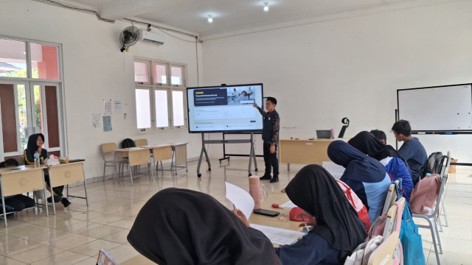
Jepara, Central Java, Ministry of Elementary and Secondary Education — The implementation of Science, Technology, Engineering, and Mathematics (STEM)-based learning at Integrated National School (SNT) 14 in Jepara takes place beyond the classroom. This approach is delivered through intracurricular and co-curricular activities that encourage students to connect knowledge to real-world problems, collaborate, and generate solutions through hands-on practice and experience.
In intracurricular activities, STEM learning is implemented through cross-disciplinary integration. One example of this is the theme "Choosing the Right Financial Products for Students," which integrates the subjects of Social Studies (Economics), Mathematics, and English.
English teacher at SNT 14 Jepara, Cahyo Tomi Prakoso, said that STEM learning builds students' abilities to solve real-world problems through scientific investigation, iterative engineering cycles, systematic modeling, and the appropriate use of technology.
"STEM learning at SNT 14 Jepara is also implemented in intracurricular activities through interdisciplinary integration. Through this interdisciplinary integration, I feel like I can build a more holistic understanding when teaching in class," said Cahyo.
In this theme, students learn about financial products and institutions through Economics. This knowledge is then combined with Mathematics to solve problems involving two-variable linear inequality systems related to financial products. Meanwhile, English develops students' ability to effectively convey arguments or opinions through Analytical Exposition Text materials and both printed and digital presentation media.

SNT 14 Jepara Mathematics Teacher Devy Rizki Agustina explained that STEM learning integrates scientific, technological, engineering, and mathematical practices into thinking and problem-solving processes. Students not only understand concepts but also use them to analyze, model, and evaluate solutions.
One of the problems given to students was to help a client with a maximum capital of Rp1 million determine a combination of two financial products with different prices. Students then used the concept of a system of linear inequalities in two variables to determine various possible combinations and analyze the most appropriate alternative options.
"In the process, the challenge faced is the differences in each student's starting point. Therefore, learning is conducted in groups so students can help each other understand concepts and solve problems," explained Devy.
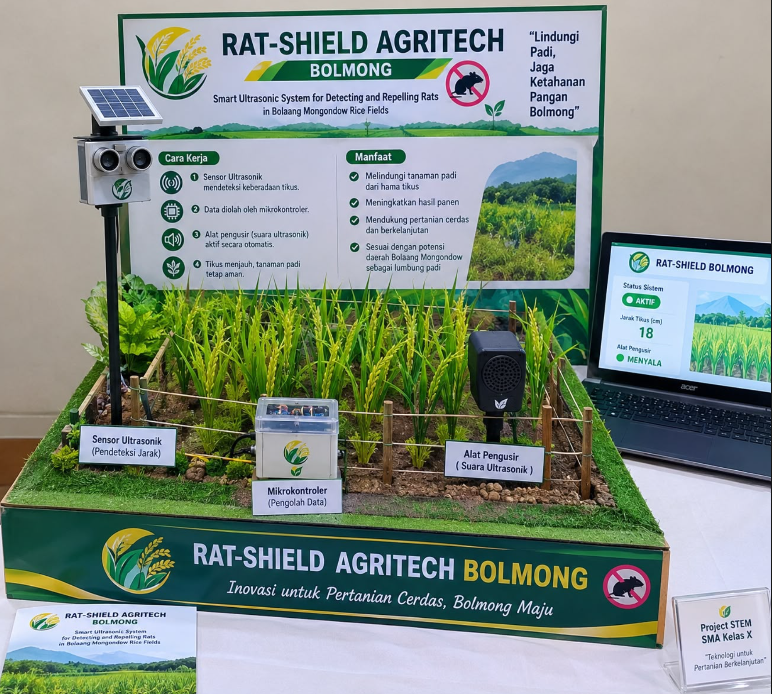
Meanwhile, the application of Science, Technology, Engineering, Art, and Mathematics (STEAM) in co-curricular activities is realized through project-based learning that highlights local potential and environmental awareness. Two projects carried out are the local food innovation SCOOPS (Fun to Create Tasty Organic Food) and COMPOS MANDIRI (Produce Black Gold to Save the Earth).
Teacher representative, Moch. Adib Irham A., said project-based learning makes the learning process more enjoyable, meaningful, and mindful. The activities also train students to hone their problem-solving skills through hands-on experience.
This is evident in the horog-horog innovation project, a traditional Jepara specialty. Students not only learn the manufacturing process but also develop innovations by integrating knowledge of ingredients, costing, technology, and packaging design to ensure local products remain relevant to the younger generation.

Teacher representative Monica Syntia Oktaviani said that project-based learning allows students to learn more than just theory, but also engage in hands-on practice, discussion, and solution-finding. She noted that the activity also demonstrates that preserving tradition can go hand in hand with innovation.
Lutfan Rasydan Faris, a junior high school student at SNT 14 Jepara, experienced this experience. He said the horog-horog innovation activity was interesting because students could directly observe the manufacturing process, ask questions to the speakers, discuss with friends, and try to create their own product innovations. "We learned to calculate costs, use technology to create designs, think about packaging, and work together in groups. This activity made learning feel more real and enjoyable," Lutfan said.

Another student, Devani Fara Maritza, said the activity gave her the opportunity to be creative with traditional regional ingredients and foods. She also learned that preserving traditional foods can be done through innovation without losing their value and identity.
In addition to food innovations, the COMPOS MANDIRI project encourages students to process organic waste from their school grounds into compost. Students learn to collect and sort waste, mix appropriate ingredients, and understand the process of converting waste into fertilizer.
Naura Lubna Agnia, a senior high school student at SNT 14 Jepara, said the activity provided a new experience, explaining that organic waste such as dried leaves and plant remains, previously considered discarded, can actually be repurposed into something useful. "This activity has made me understand more clearly that the knowledge learned in school can be directly applied in everyday life," Naura said.

Echoing Naura, Muhammad Azka Labib Atmaja believes that composting makes learning more engaging because students can see and experience the process themselves. Besides understanding waste management, he also learned to work collaboratively, share tasks, discuss issues, and find solutions when faced with obstacles.
Through these intracurricular and cocurricular activities, SNT 14 Jepara presents STEM/STEAM as a learning experience that connects knowledge to real life. Students are trained to think critically, solve problems, collaborate, utilize technology, and generate solutions to issues relevant to their lives.

This practice also demonstrates that STEM/STEAM learning can provide a space for students to develop knowledge and awareness of the environment and regional potential. From the classroom to the school environment, learning is directed so that knowledge does not remain theoretical, but grows into experience, skills, and good habits in everyday life.*** (Author: Shaka / Editor: Denty / Documentation: SNT 14 Jepara Team)
Bureau of Communication and Public Relations
Secretariat General
Ministry of Primary and Secondary Education
Website: kemendikdasmen.go.id
X: x.com/Kemdikdasmen
Instagram: instagram.com/kemendikdasmen
Facebook: facebook.com/kemendikdasmen
YouTube: Ministry of Education and Culture
Questions and Complaints: ult.kemendikdasmen.go.id
Press Release from the Ministry of Primary and Secondary Education: kemendikdasmen.go.id/pencarian/siaran-pers
#QualityEducationforAll
#MinistryOfEducationAndEducationFriendly