



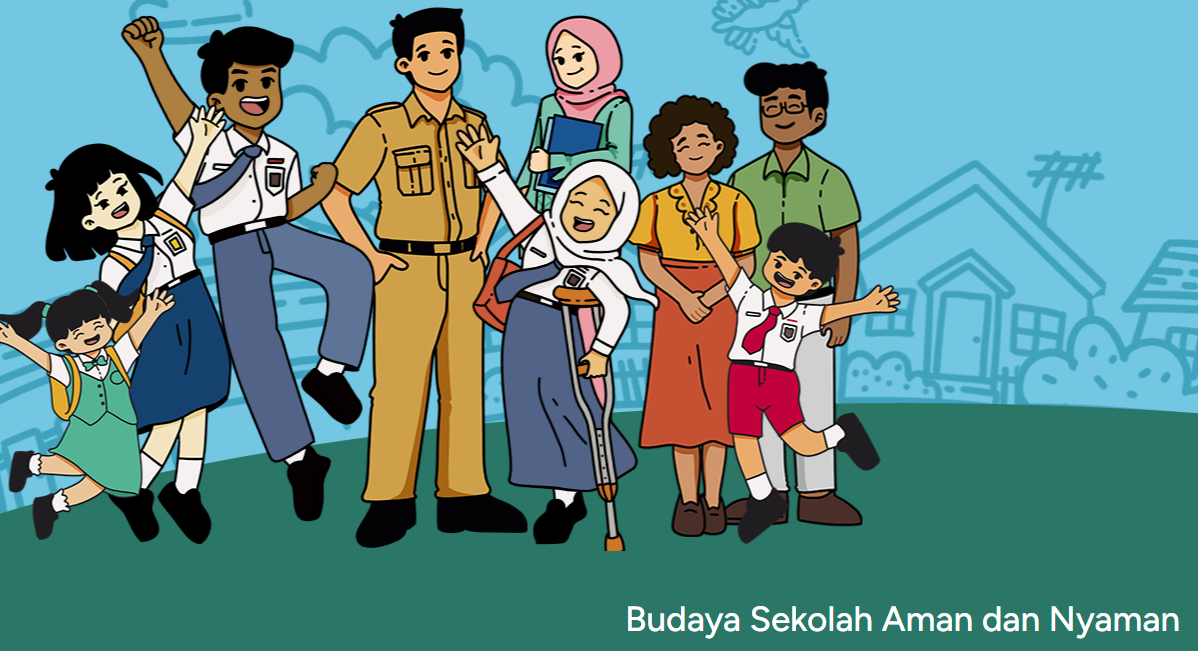
South Tangerang, February 25, 2026 – Continuing the major commitment announced last January, the Ministry of Primary and Secondary Education (Kemendikdasmen) is now moving into the operational and technical strengthening phase. Through a webinar, Kemendikdasmen detailed the implementation mechanism of Ministerial Regulation of Primary and Secondary Education Number 6 of 2026 concerning a Safe and Comfortable School Culture.
This webinar was attended by the Chairpersons and Administrators of the Education Community, namely the Education Personnel Working Group (K3TK), the Principal Working Group (K3S), the Principal Working Group (MKKS), the Teacher Working Group (KKG), the Subject Teachers' Meeting (MGMP), and the Guidance and Counseling Meeting (MBGK) from all over Indonesia, as an effort to ensure that national policies can be translated appropriately at the educational unit level.
This activity is a follow-up to the Minister of Primary and Secondary Education Regulation Number 6 of 2026, which was issued on January 8, promulgated on January 9, and officially launched on January 12, 2026, by the Minister of Primary and Secondary Education, Abdul Mu'ti. Furthermore, to support implementation in the field, the Ministry of Primary and Secondary Education also issued Ministerial Decree Number 17 of 2026 concerning Guidelines for Implementing a Safe and Comfortable School Culture.
Paradigm Shift: from Reactive to Promotive and Preventive
In her remarks at the opening of the event, the Secretary General of the Ministry of Primary and Secondary Education, Suharti, emphasized that this regulation shifts the policy paradigm from a reactive one to an approach that prioritizes promotive, preventive, and collaborative efforts, as part of a joint effort to build a safe and comfortable school culture.

"Schools are no longer positioned solely as spaces for resolving violations after problems arise. With this new regulation, we are encouraging schools to become living spaces that foster values, strengthen character, and prevent violence, bullying, and various forms of discomfort from an early age," said Suharti on Tuesday (February 24). She added that efforts to build a positive culture are far more impactful than simply addressing problems downstream.
This Ministerial Regulation covers four aspects of a safe and comfortable school culture: spiritual needs fulfillment, physical protection, psychological well-being and sociocultural security, and digital civility and security. This regulation is implemented based on nine principles: humanism, comprehensiveness, participatory, best interests of the child, non-discrimination, inclusiveness, justice and gender equality, harmony, and sustainability.
Students as Positive Cultural Agents and the Formation of Regional Working Groups in 6 Months
The Director General of Early Childhood Education, Primary and Secondary Education (PAUD Dikdasmen), Gogot Suharwoto, emphasized the central role of students in this regulation. Schools are encouraged to actively involve students as subjects, not just objects of policy. "Through the #RukunSamaTeman and #FriendsGreat movements, students are encouraged to become agents of positive culture in schools and digital spaces," explained Gogot. Students are also involved in drafting class agreements so that rules are understood and shared.

Technically, one of the main mandates in this regulation requires Regional Governments to establish a Working Group (Pokja) on Safe and Comfortable School Culture no later than six months after the regulation's issuance. This Working Group is designed to be more empowered by involving various sectors. The Regional Secretary (Sekda) will act as the Head of the Working Group, and the Head of the Education Office will serve as the Coordinator. This aims to ensure that addressing school issues is not solely the school's responsibility, but is supported by integrated planning, budgeting, and oversight.
Strengthening the Role of Teachers and Education Personnel and Management of Handling
From the educator perspective, the Director General of Teachers and Education Personnel, Nunuk Suryani, outlined a more precise division of roles. At the early childhood education and elementary levels, strengthening parenting, character building, and physical and emotional protection of students are the focus of the roles of classroom teachers, religious teachers, and physical education teachers as the frontline in schools. Meanwhile, at the secondary education level, these roles are strengthened through the involvement of Guidance and Counseling (BK) teachers, homeroom teachers, and the vice principal for student affairs in early detection, rapid response, and the provision of integrated psychosocial services.

In terms of governance, Minister of Primary and Secondary Education Regulation No. 6 of 2026 regulates two complementary handling mechanisms. First, non-criminal cases are handled by schools through enforcement of regulations and codes of ethics using a collaborative case management approach. Second, violations related to statutory regulations are handled through Working Groups (Pokja) at the local government level using a cross-sectoral referral mechanism.
In line with these provisions, the transitional provisions in this regulation confirm that the Violence Prevention and Handling Team (TPPK) at the school level and the PPKSP Task Force at the regional level are declared invalid and replaced by a new, more participatory and integrated mechanism.
Protection in the Digital Space
Responding to the dynamics of the times, this Ministerial Regulation also places special emphasis on digital security. Schools are required to ensure the protection of students' personal data and protect them from negative content and cybercrime by integrating digital ethics into the learning process.
"The success of building a safe and comfortable culture is the collective effort of the Four Education Centers (schools, parents, the community, and the media). We want to ensure that every child who steps into school enters a safe, comfortable space that honors their dignity as human beings," concluded the Director General of Vocational Education, Tatang Muttaqin.

Tatang also emphasized the importance of parents' role as school partners in building a strong and sustainable learning environment, including mentoring children in digital spaces to protect them from negative content and cybercrime.
Further information regarding the technical implementation of a Safe and Comfortable School Culture can be accessed through the official website: https://cerdasberkarakter.kemendikdasmen.go.id/budayasekolahamannyaman . *** (Author: Uly, Puspeka Team / Editor: Denty A., Seno H. / Documentation: Kemendikdasmen Team)
Bureau of Communication and Public Relations
Secretariat General
Ministry of Primary and Secondary Education
Website: kemendikdasmen.go.id
X: x.com/Kemdikdasmen
Instagram: instagram.com/kemendikdasmen
Facebook: facebook.com/kemendikdasmen
YouTube: Ministry of Education and Culture
Questions and Complaints: ult.kemendikdasmen.go.id
Press Release from the Ministry of Primary and Secondary Education: kemendikdasmen.go.id/pencarian/siaran-pers
#QualityEducationforAll
#MinistryOfEducationAndEducationFriendly