



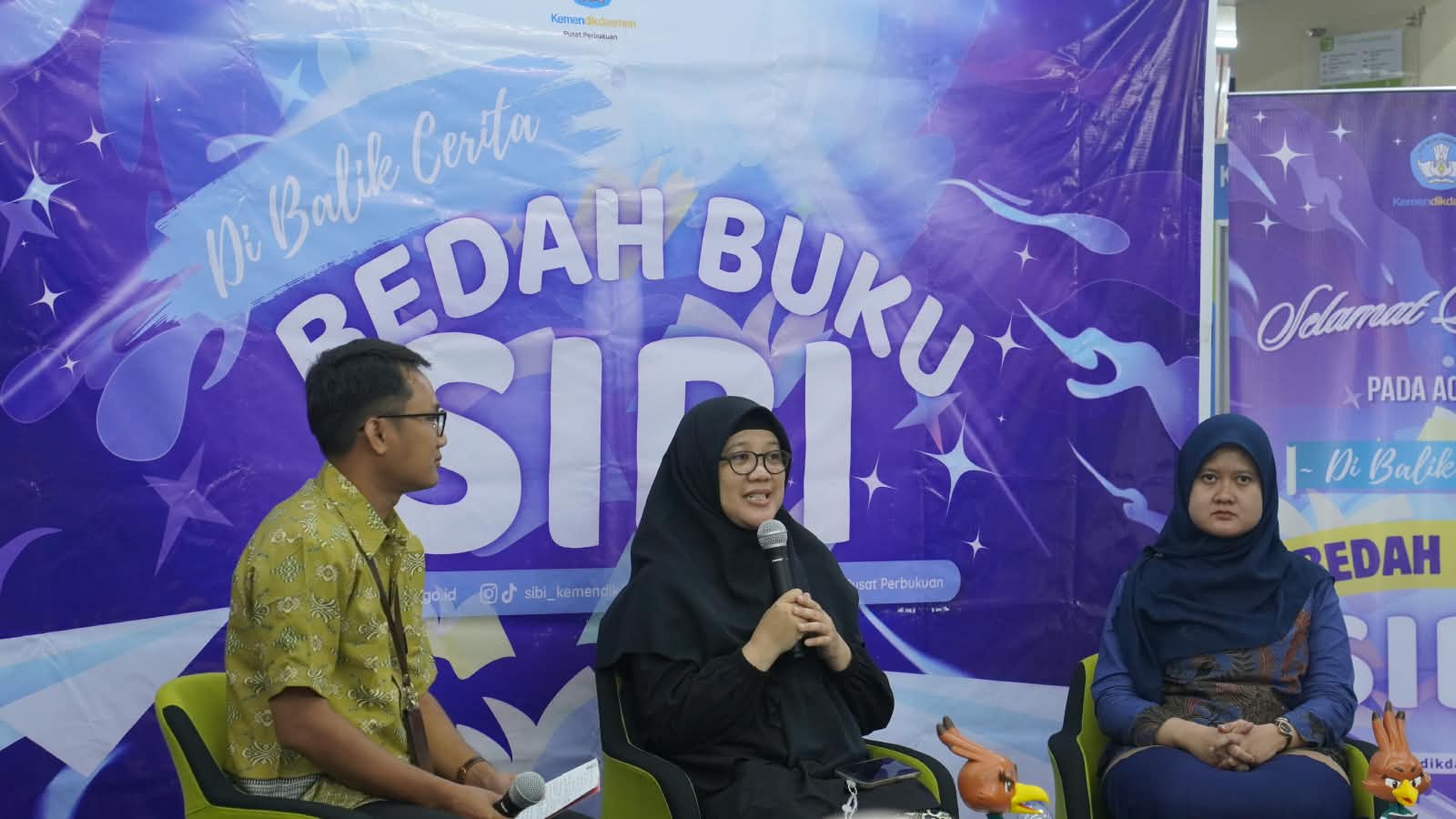
Jakarta, September 29, 2026 – Books don't always have to be serious, text-heavy reading materials. Comics can be a gateway to introducing knowledge and fostering children's interest in reading. This is illustrated in the book "Buah Ajaib," a comic that explores nutmeg through stories, visuals, and information about its benefits and history.
The comic book by Tuti Adhayati was reviewed in the "Balik Cerita" Series Book Review event held by the Book Center, Elementary and Secondary Education Policy Agency (BKPDM), Ministry of Elementary and Secondary Education (Kemendikdasmen), at the Kemendikdasmen Library, Jakarta, on Tuesday (29/9).
In his message, the Head of the Book Center, Supriyatno, stated that the book review activity is an effort to increase literacy and introduce books published by the Book Center, as well as works by authors and various institutions, to the public. "The book review is an effort to increase literacy, introduce books published by the Book Center, as well as books written by authors and various institutions," Supriyatno said.

On the occasion, Tuti Adhayati, author of "Buah Ajaib," explained that the idea for the comic book stemmed from her interest in nutmeg. She noted that many people, including adults, still don't fully understand the nutmeg seed's form or its many benefits. "Nutmeg isn't just for making soto (soup) or just as a spice. It can also be processed into medicines and perfumes, and many other things are integral to our lives without us even realizing it," Tuti said.
Based on this interest, Tuti explained that she conducted research on nutmeg, including its benefits, processing, and history as a commodity that once captured global attention. "Indonesia has a spice that was once highly prized, but now it's perhaps more commonplace," she said.
Tuti chose a comic book format for her writing process so that information about nutmeg could be absorbed by children in a fun way. She envisioned a book full of pictures and color, yet still conveying information. "The main thing is, it has to have lots of pictures and color, so that children don't find it boring and awkward to read," she said.
Tuti then identified the target audience for elementary school. According to Tuti, information in children's books needs to be presented simply to avoid burdening readers' concentration. She also chose one issue as part of the storyline: the mushroom problem related to nutmeg. Information about the benefits and content of nutmeg was then incorporated into the story through situations experienced by the characters in the comic. "So the main goal is to ensure that information about the problem in the comic is still conveyed, but children don't feel like they are being pressured to think hard," Tuti explained.

In addition to being a reading material, the comic book 'Buah Ajaib' has also been used as a contextual learning resource by a teacher at Bosowa Bina Insani Bogor Middle School, Kharisma Prawesti Sri Utami, who sees the story of Nutmeg as a magical fruit in the comic as a starting point for students to find problems, design solutions, and connect them to various fields in STEM learning.
Kharisma explained that after reading the comic, students can be encouraged to identify issues raised in the story, such as the fungus on nutmeg seeds. From there, they can be encouraged to brainstorm possible solutions to address these issues.
He explained that the engineering approach in STEM doesn't always have to involve machines or technology. Instead, students can be encouraged to design or engineer solutions based on the problems they encounter in the story. "Because engineering isn't just about machines; designing or engineering solutions is part of engineering learning," he said.
Kharisma further explained that mathematical concepts can also be introduced through simple activities. For example, students can be asked to calculate the size of a nutmeg drying rack or estimate the drying time. "After reading the comic, we can provide a worksheet containing questions about problems encountered in the story and solutions that students can devise," Kharisma said.
According to Kharisma, STEM learning does not stop at science. The contents of the comic book 'Magic Fruit' can also be linked to social studies, for example by discussing nutmeg as an export commodity and how product processing can provide economic value.
"Talking about STEM isn't just about science, it can also be about other subjects, such as comics, which can be linked to social studies, specifically about export commodities or how to improve the economy by processing them," he concluded.

The hope is that with this approach, a comic will not only be a reading material but also spark curiosity. The story about nutmeg can encourage students to read, identify problems, ask questions, calculate, devise solutions, and learn about Indonesia's potential.*** (Writer: Ririn / Editor: Stephanie, Seno / Photographer: BKPDM Team)
Bureau of Communication and Public Relations
Secretariat General
Ministry of Primary and Secondary Education
Website: kemendikdasmen.go.id
X: x.com/Kemdikdasmen
Instagram: instagram.com/kemendikdasmen
Facebook: facebook.com/kemendikdasmen
YouTube: Ministry of Education and Culture
Questions and Complaints: ult.kemendikdasmen.go.id
Press Release from the Ministry of Primary and Secondary Education: kemendikdasmen.go.id/pencarian/siaran-pers
#QualityEducationforAll
#MinistryofEducationAndEducationFriendly