



Find information about the Ministry of Education and Culture, organizational structure, and regulations.
Profile Information of Kementerian Pendidikan Dasar dan Menengah
Public Information of Kementerian Pendidikan Dasar dan Menengah
Find news, press releases, announcements, and official documentation from Kemendikdasmen
 Home
Profile
Home
Profile
Find information about the Ministry of Education and Culture, organizational structure, and regulations.
About Us
Profile Information of Kementerian Pendidikan Dasar dan Menengah
Profiles of Officials
Public Information
Public Information of Kementerian Pendidikan Dasar dan Menengah
LHKPN Report
Laporan Moch. Abduh
Laporan LHKPN Fajar Riza Ul Haq
Laporan LHKPN Atip Latipulhayat
Laporan LHKPN Suharti
Laporan Abdul Mu'ti
Laporan Faisal Syahrul
Laporan Nunuk Suryani
Laporan Gogot Suharwoto
Laporan Tatang Muttaqin
Laporan Toni Toharudin
Laporan Hafidz Muksin
Laporan Biyanto
Laporan Mariman Darto
Laporan Didik Suhardi
Laporan Muhammad Muchlas Rowi
Laporan Ma'ruf
Laporan Rita Pranawati
Publication
Find news, press releases, announcements, and official documentation from Kemendikdasmen
PPID
Ministry of Education and Culture Discusses Coding and AI Learning for Elementary School Students


Published on: 29 November 2024
Share:
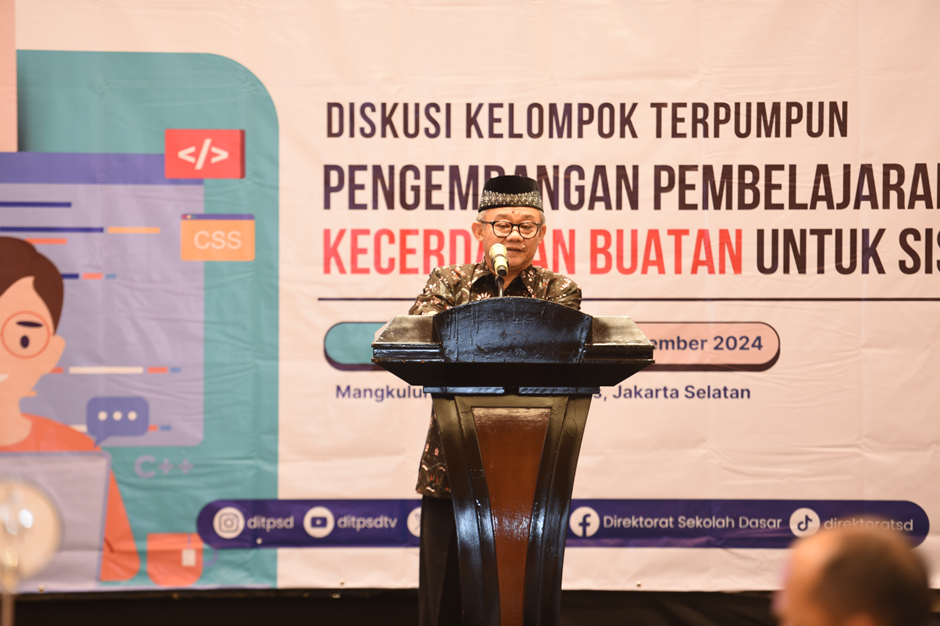
Jakarta, November 29, 2024 – The Ministry of Primary and Secondary Education (Kemendikdasmen) through the Directorate of Primary Schools, Directorate General of Early Childhood Education, Primary Education, and Secondary Education (Ditjen PAUD Dikdasmen), held a Focus Group Discussion activity with the theme "Development of Coding and Artificial Intelligence Learning for Primary School Students".
The activity, which took place from November 29 to December 1, 2024, was also attended by the Minister of Primary and Secondary Education (Mendikdasmen), Abdul Mu'ti, Deputy Minister of Primary and Secondary Education (Wamendikdasmen), Atip Latipulhayat, Special Staff to the Minister for Digital Transformation and Artificial Intelligence, Muhammad Muchlas Rowi, Special Staff to the Minister for Management and Institutions, Didik Suhardi, Secretary of the Directorate General of Early Childhood Education and Elementary and Secondary Education, Praptono, along with school principals, teachers, and the coding and artificial intelligence teaching community.
This discussion aims to develop effective learning strategies related to coding and artificial intelligence (AI) to be included in the elementary school curriculum in the 2025-2026 school year. The main focus of this activity is to provide children with 21st-century skills, particularly those that support mastery of rapidly evolving digital technologies. The presence of technologies such as coding and AI is expected to strengthen collaboration, creativity, and digital literacy skills, which are highly needed in today's digital workplace.
In his remarks, Minister of Primary and Secondary Education Abdul Mu'ti emphasized the importance of learning coding and artificial intelligence as part of efforts to prepare a competitive and globally competitive young generation. He stated that with the rapid development of digital technology, skills such as coding and AI will significantly assist Indonesian children in facing the challenges of the times.
"As we know, many developed countries have started teaching high-tech subjects like coding and AI at an early age. We also plan to introduce this learning starting in elementary school, with plans to make it an elective subject in the 2025-2026 academic year," said Minister Mu'ti in Jakarta on Friday (November 29).
"We greatly appreciate the feedback we've received on this matter, and of course, we'd love to hear more to ensure this learning can be effectively implemented across Indonesia," he added.
Furthermore, Minister Mu'ti said that although there were some pros and cons to this policy, most of the positive responses received came from parties who understood the importance of digital skills for Indonesian children.
"While some argue that basic literacy is more important, we believe that mastery of technology will actually support the development of our children's literacy and numeracy," he added.
On the same occasion, Deputy Minister of Primary and Secondary Education, Atip Latipulhayat, who also attended as a keynote speaker, emphasized the importance of understanding coding and AI as part of digital literacy. In his presentation, Deputy Minister Atip reflected on technology education in Indonesia and compared it with developed countries that have long integrated technology education, such as coding and AI.
"Just as education on space technology was introduced in the United States in the 1970s, we want to ensure that Indonesia's younger generation is not left behind in terms of technological mastery," he said.
"Coding and AI aren't scary; they actually open up huge opportunities for children to develop creativity and innovation. We hope that by introducing technology at an early age, our children will be prepared to enter the increasingly complex digital world," he continued.
Meanwhile, Praptono, Secretary of the Directorate General of Early Childhood Education and Primary and Secondary Education, stated in his report that coding and AI are not merely technological tools but also essential skills that young people must possess. He believes these skills will help children become creative and innovative individuals, ready to face future global challenges, whether in climate change, health, or other areas.
"Through this activity, we hope to gather insights and input from various parties regarding the urgency of learning coding and AI for young students. We also hope to formulate strategies that are not only effective in facilitating the development of digital skills but also maintain balance with other foundational subjects," explained Praptono.
This activity is expected to generate various practical recommendations that can be implemented in the Indonesian education system, particularly regarding the teaching of coding and AI in elementary schools. Participants are expected to contribute to designing an appropriate curriculum structure and developing learning modules that are accessible to all schools across Indonesia, considering the varying conditions of educational facilities in various regions.
Ultimately, this event will mark a significant step in preparing a generation of Indonesians who are better prepared to face the challenges of the 21st century, through mastery of relevant digital skills balanced with a solid basic education.
This activity is part of the Ministry of Education and Culture's initiative to introduce digital technology and education into the Indonesian curriculum, with the goal of producing a creative, innovative generation ready to face increasingly complex global challenges. Coding and artificial intelligence learning is expected to become an integral part of a more equitable education system across Indonesia. 

Bureau of Cooperation and Public Relations
Secretariat General
Ministry of Primary and Secondary Education
Website: kemdikbud.go.id
X: x.com/Kemdikdasmen
Instagram: instagram.com/kemendikdasmen
Facebook: facebook.com/kemendikdasmen
YouTube: Ministry of Education and Culture
Questions and Complaints: ult.kemdikbud.go.id
Source: Siaran Pers Kementerian Pendidikan Dasar dan Menengah Nomor: 600/sipers/A6/XI/2024
Writer: Penulis BKHM
Editor: Editor_BKHM
 PaudDikdasmen
Ruang Murid
Ruang GTK
Ruang Sekolah
GTK
PaudDikdasmen
Ruang Murid
Ruang GTK
Ruang Sekolah
GTK