



Find information about the Ministry of Education and Culture, organizational structure, and regulations.
Profile Information of Kementerian Pendidikan Dasar dan Menengah
Public Information of Kementerian Pendidikan Dasar dan Menengah
Find news, press releases, announcements, and official documentation from Kemendikdasmen
 Home
Profile
Home
Profile
Find information about the Ministry of Education and Culture, organizational structure, and regulations.
About Us
Profile Information of Kementerian Pendidikan Dasar dan Menengah
Profiles of Officials
Public Information
Public Information of Kementerian Pendidikan Dasar dan Menengah
LHKPN Report
Laporan Moch. Abduh
Laporan LHKPN Fajar Riza Ul Haq
Laporan LHKPN Atip Latipulhayat
Laporan LHKPN Suharti
Laporan Abdul Mu'ti
Laporan Faisal Syahrul
Laporan Nunuk Suryani
Laporan Gogot Suharwoto
Laporan Tatang Muttaqin
Laporan Toni Toharudin
Laporan Hafidz Muksin
Laporan Biyanto
Laporan Mariman Darto
Laporan Didik Suhardi
Laporan Muhammad Muchlas Rowi
Laporan Ma'ruf
Laporan Rita Pranawati
Publication
Find news, press releases, announcements, and official documentation from Kemendikdasmen
PPID
PISA 2025: Literacy and Science Scores Rise, Education Access Jumps 90 Percent


Published on: 8 September 2026
Share:
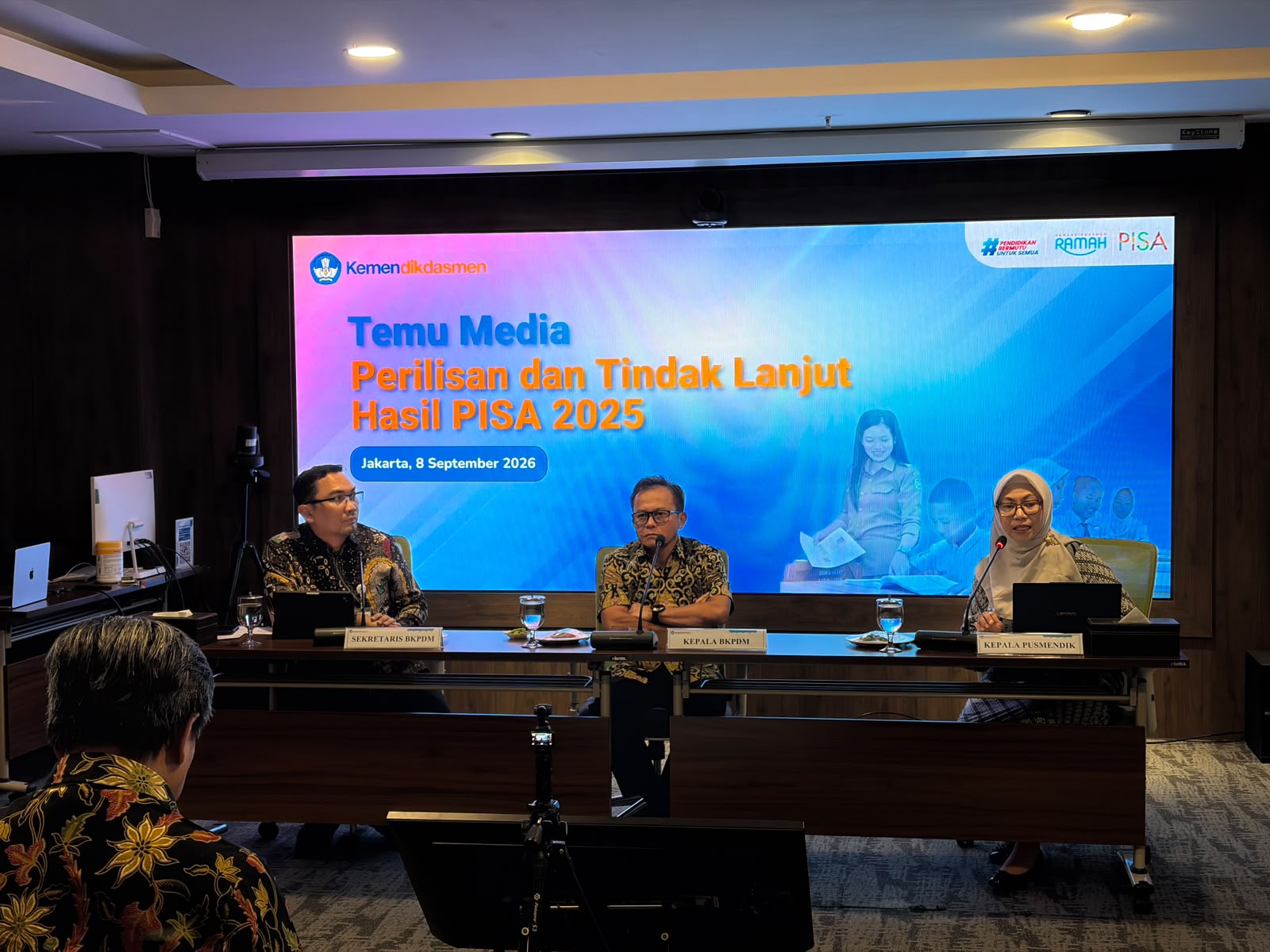
Jakarta, September 8, 2026 — The Organization for Economic Co-operation and Development (OECD) released the results of the Programme for International Student Assessment (PISA) 2025, which was participated by 91 countries/economies and involved more than 760 thousand sample students worldwide, which is the largest participation since PISA was first held in 2000. These results show that Indonesia has succeeded in expanding access to education massively without sacrificing the quality of learning. "Amidst the downward trend in science, reading, and mathematics scores in OECD countries over the past 25 years, Indonesia's educational performance has been relatively stable, and Indonesia has even improved in literacy and science," explained Toni Toharudin, Head of the Primary and Secondary Education Policy Agency, Ministry of Primary and Secondary Education. The Ministry of Primary and Secondary Education (Kemendikdasmen) recorded improvements in two key domains of the PISA 2025 assessment, with science literacy, the primary focus of this year's assessment, achieving the highest achievement. The science score rose 6 points, from 383 in PISA 2022 to 389. The reading score also rose 6 points, from 359 to 365. Meanwhile, the mathematics score stood at 364. This achievement is even more significant when considering the Coverage Index , the proportion of 15-year-old students enrolled in the formal education system. In its first PISA 2003 participation, Indonesia's Coverage Index was only 0.46. By PISA 2025, this figure had nearly doubled to 0.90. This demonstrates the significant expansion of educational access across Indonesia, particularly since Indonesia's full transition from paper-based tests (PBT) to computer-based tests (CBT) starting in PISA 2018. The OECD's Director of Education and Skills, Andreas Schleicher, commended Indonesia for its achievements, which he said have successfully addressed the challenge facing many countries: expanding access to education without sacrificing quality. OECD data shows that 15-year-olds in Indonesia have among the highest levels of curiosity and have developed independent learning skills. Indonesian students also perform better in computational problem-solving than in more conventional subjects, and are more frequently engaged in learning to assess the credibility of artificial intelligence (AI)-generated content than students in many other countries around the world. Following up on the results of the 2025 PISA, the Ministry of Education and Culture has established four main strategic pillars. First, strengthening teacher competency through academic qualifications, Teacher Professional Education (PPG), and strengthening pedagogical and digital competencies, including coding and artificial intelligence. Second, improving the quality of learning through the implementation of in-depth learning, digitalization of learning, and strengthening literacy-numeracy and student character. Third, harmonizing the National Assessment (AN) and Academic Ability Test (TKA) frameworks with the reasoning competencies in the PISA framework. Fourth, strengthening the role of families through the 7 Habits of Great Indonesian Children (7KAIH) Movement and strengthening parental partnerships in in-depth learning. As a support, Keme Website: kemendikdasmen.go.id #QualityEducationforAll
 ndikdasmen provides a number of learning and assessment platforms that teachers and students can access independently, including the Ruang GTK Teaching Device (guru.kemendikdasmen.go.id/perangkat-ajar), Ruang Murid (rumah.pendidikan.go.id/ruang/murid), and the Pusmendik assessment simulation and practice portal (pusmendik.kemendikdasmen.go.id. These various platforms are designed to strengthen students' reasoning skills, digital literacy, and learning independence in line with the PISA assessment framework.*** (Author: Uly/Photographer: Morecka/Editor: Rany)
Bureau of Communication and Public Relations
Secretariat General
Ministry of Primary and Secondary Education
X: x.com/Kemdikdasmen
Instagram: instagram.com/kemendikdasmen
Facebook: facebook.com/kemendikdasmen
YouTube: Ministry of Education and Culture
Questions and Complaints: ult.kemendikdasmen.go.id
Press Release from the Ministry of Primary and Secondary Education: kemendikdasmen.go.id/pencarian/siaran-pers
#MinistryOfEducationAndEducationFriendly
Source: Siaran Pers Kementerian Pendidikan Dasar dan Menengah Nomor: 797/sipers/A6/IX/2026
Writer: Uly
Editor: Denty Anugrahmawaty
 PaudDikdasmen
Ruang Murid
Ruang GTK
Guru Dikdasmen
Sekolah Dikdasmen
Murid Dikdasmen
PaudDikdasmen
Ruang Murid
Ruang GTK
Guru Dikdasmen
Sekolah Dikdasmen
Murid Dikdasmen