



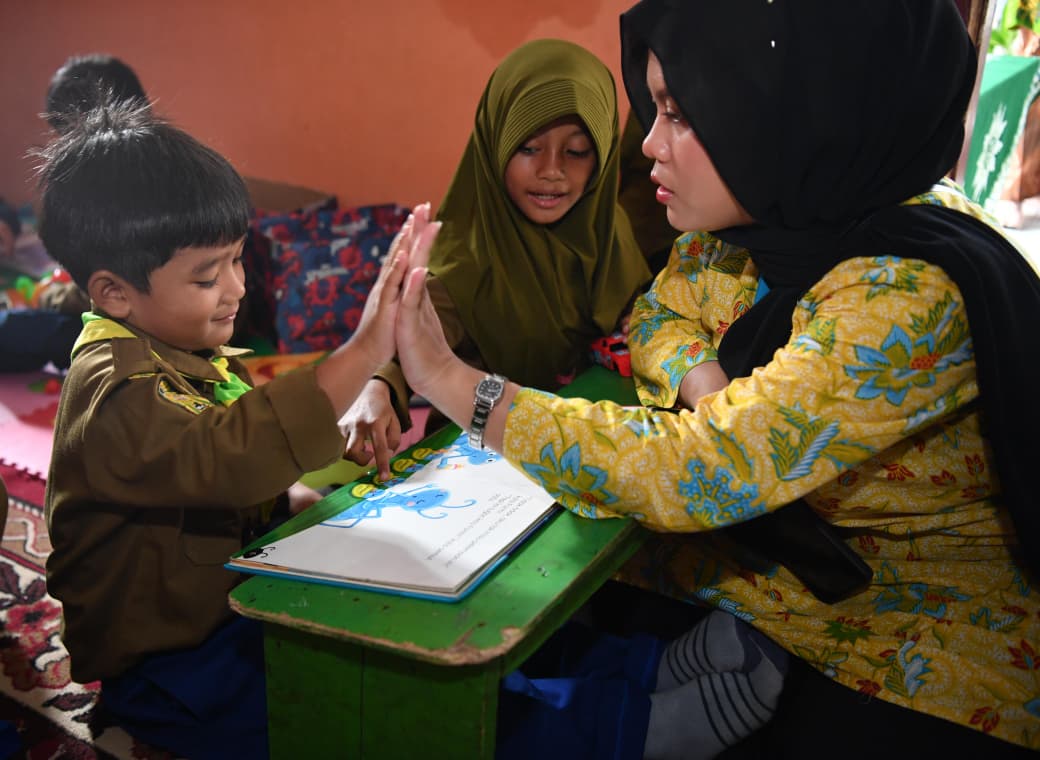
Jakarta, September 20, 2025 - The Ministry of Primary and Secondary Education (Kemendikdasmen) continues to strengthen its commitment to providing quality and equitable education for all Indonesian children. This commitment is realized through two complementary strategic policies: the S-1/D-4 academic qualification program for kindergarten and elementary school teachers, and the strengthening of the 13-year compulsory education policy that integrates one year of preschool education.
In a media dialogue forum attended by officials from the Ministry of Primary and Secondary Education, representatives from the Human Resource Development Agency (BKHM), and 36 national journalists, the Secretary General of the Ministry, Suharti, emphasized the crucial role of the mass media as a strategic partner. "Early childhood education is the primary foundation for human resource development. Therefore, fulfilling the qualifications of early childhood education (PAUD) and elementary school (SD) teachers, as well as ensuring compulsory preschool education, is a priority to ensure equitable and high-quality education services," Suharti said.
Recent data shows that there are still around 233,000 teachers who do not have a Bachelor's or Diploma IV qualification, the majority of whom come from formal early childhood education (PAUD) and elementary schools. In fact, of the 637,445 formal and non-formal PAUD teachers throughout Indonesia, almost half do not have a bachelor's degree. Yet, teacher quality has been proven to be key to the success of early childhood education. To this end, the Ministry of Education and Culture has launched an academic qualification affirmation program targeting teachers who do not yet have a Bachelor's or Diploma IV degree, are 55 years old or older, and are registered with Dapodik. The selection process is not only based on formal documents but also considers teaching experience portfolios, seminar participation, and involvement in learning activities.
The Director of Early Childhood Education and Non-Formal Education (PAUD) Teachers, Suparto, explained that a child's brain develops up to 80 percent before the age of six, so PAUD teachers play a vital role in shaping a child's character, intelligence, and social skills. He also highlighted the Recognition of Prior Learning (RPL) scheme, which allows experienced teachers to complete their studies faster: two semesters for teachers aged 47–55, and an average of two to four semesters for teachers under 47.
As a form of concrete support, the government provides a maximum of IDR 3 million per semester per teacher. By 2025, the program targets 12,500 participants, consisting of 6,745 kindergarten teachers and 5,755 elementary school teachers, who will study at 91 LPTKs across Indonesia. However, several challenges have emerged, ranging from low motivation among senior teachers, health issues, and distance to lecture locations. Therefore, online and hybrid learning modes are being maximized to ensure teachers from remote areas still have equal access. Furthermore, the program's implementation, with a monitoring and evaluation system, learning contracts, and flexible final assignments, is designed to ensure the program can be completed without disrupting teaching duties.
This affirmative action policy is a follow-up to the President's directives on National Education Day 2025, as well as part of the "80th Anniversary of the Republic of Indonesia's Gift for Teachers" package, which also includes incentives for non-ASN teachers and wage subsidy assistance for non-formal PAUD teachers.
In addition to improving teacher qualifications, the Ministry of Education and Culture is also preparing a Grand Design for 13 Years of Compulsory Education, which includes nine years of primary education, three years of secondary education, and one year of preschool. Nia Nurhasanah, Director of Early Childhood Education (PAUD), Directorate General of Early Childhood Education, Primary Education, and Secondary Education (Ditjen PAUD Dikdasmen), emphasized that the 5–6 year age period is a golden period for child development, making preschool a priority.

These efforts are being implemented through the expansion of formal and non-formal early childhood education (PAUD) services, the construction of new schools, the nationalization of PAUD, the revitalization of PAUD units, and the development of a one-stop PAUD-SD model in underdeveloped and remote areas with minimal access. The enjoyable PAUD-to-SD transition program is also being strengthened to ensure PAUD learning outcomes align with those of grades 1–2. "Since 2023, the curriculum and textbooks have been adjusted to ensure there is no gap between PAUD and elementary school learning. We want the transition to be smooth and enjoyable for children," explained Nia.
The government is also intensifying pedagogical strengthening through STEM approaches, religious and character education, mother tongue education, and inclusive values. Partnerships with 75 educational organizations have also been established with specific follow-up plans, reflecting universal participation in building the future of Indonesian children's education. However, several questions remain, including those related to the financing of compulsory preschool education, the status of educators if PAUD is nationalized, and the rules for elementary school entry for 6-year-olds. Responding to this, Nia emphasized that the government is currently focused on expanding access, while continuing to formulate regulations and financing schemes.
The dialogue concluded with a call for collaboration from the Ministry of Primary and Secondary Education to all stakeholders. "We need everyone's support to convey the importance of early childhood education (PAUD) for the future of Indonesian children. Quality education can only be achieved if qualified teachers, equal access, and public participation go hand in hand," Nia concluded.
With these two strategic policies, improving the qualifications of PAUD-SD teachers and 13 years of compulsory education, the Ministry of Elementary and Secondary Education hopes that quality education services will truly be felt equally, while also elevating the dignity of teachers as the spearhead of the development of superior human resources in Indonesia.*** (Authors: Avina, Nabila, Denty A./Editor: GTKPG Directorate General Team, Seno H./Documentation: BKHM)

Bureau of Communication and Public Relations
Secretariat General
Ministry of Primary and Secondary Education
Website: kemendikdasmen.go.id
X: x.com/Kemdikdasmen
Instagram: instagram.com/kemendikdasmen
Facebook: facebook.com/kemendikdasmen
YouTube: Ministry of Education and Culture
Questions and Complaints: ult.kemendikdasmen.go.id
Press Release from the Ministry of Primary and Secondary Education: kemendikdasmen.go.id/pencarian/siaran-pers
#QualityEducationforAll
#MinistryOfEducationAndEducationFriendly