



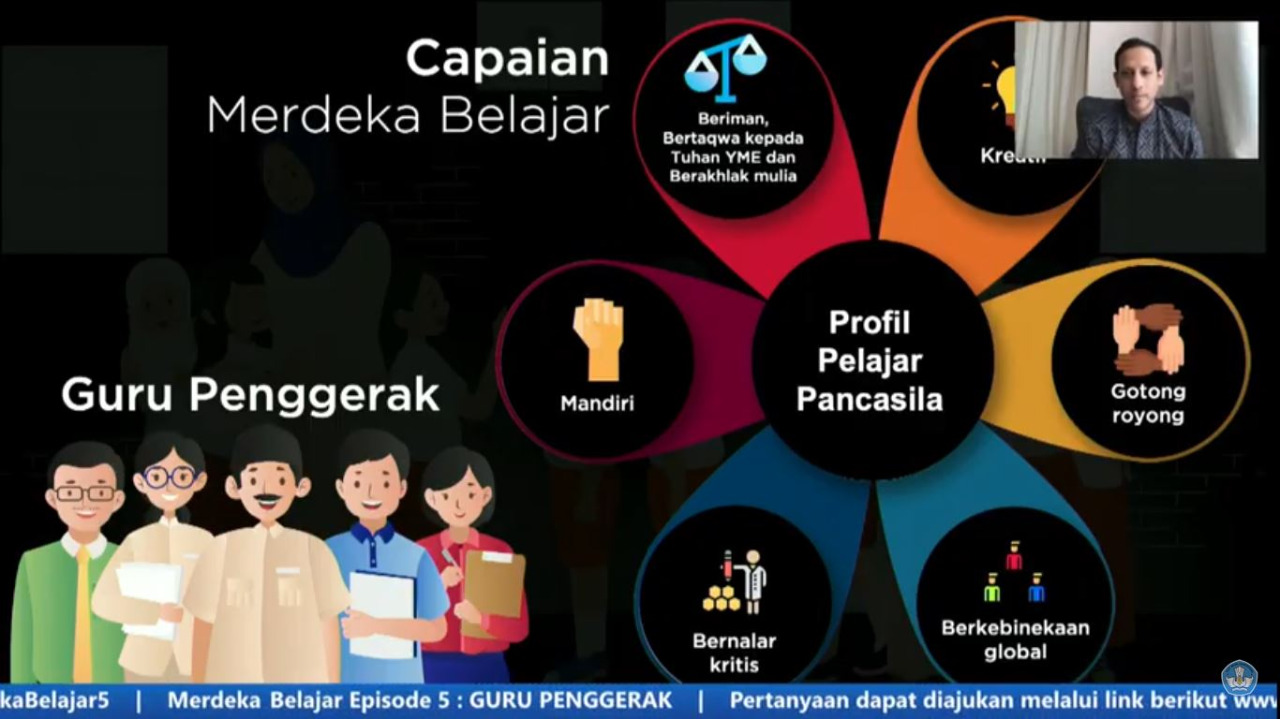
Jakarta, Ministry of Education and Culture --- Minister of Education and Culture (Mendikbud) Nadiem Makarim held an online discussion with two school principals regarding innovations and best practices in school learning. The discussion took place amidst the launch of the Merdeka Belajar Episode 5: Teachers as Leaders policy, via online video conference on Friday (July 3, 2020). In the discussion, the Minister of Education and Culture stated that change is impossible if teachers and educational unit leaders do not believe in children's potential.
"If we have a mentality of giving up easily and don't believe in our children's potential, it's impossible to achieve a leap in the quality of learning, or if we don't believe that children can be much better than they are now. Teachers must have optimism, confidence, and faith that children's potential lies within and only needs to be unleashed, facilitated, and developed," said Minister of Education and Culture Nadiem Makarim.
According to the Minister of Education and Culture, teachers and principals must create a school environment that maximizes the potential of their students. Educators must be able to adapt to each child's varying abilities and competency levels. "Because the most important thing is not that all children meet the same standards. What's most important is that each child learns and that each child improves their capacity," he said.
He also emphasized the importance of assessing a child's psychological well-being before starting school. When a child feels stressed, they will also feel uncomfortable and lack confidence in participating in learning. "Many people don't realize the connection between a fun school environment and learning. Yet, the relationship between a child's psychological well-being at school and their learning potential is exponential," the Minister of Education and Culture said.
The different potential of each child and the different psychological conditions of each child are what Mariance Wila Dida and Nyoman Darta pay attention to when implementing innovative learning methods in the schools they lead.
Mariance Wila Dida is the Principal of SDN 9 Masohi, Central Maluku. Since 2016, the woman familiarly known as Ibu An has led her school to transform into a child-friendly school that supports student learning. Initially, Ibu An was skeptical that students could be disciplined without being hit. However, after implementing positive discipline and active student-centered learning, she saw a positive impact on both students and teachers. Now, Ibu An is a Community Leader for Child-Friendly Schools in Central Maluku, assisting schools in Masohi in transforming into Child-Friendly Schools. As a result, students are able to resolve conflicts without violence, greet each other, are enthusiastic, and learn independently.
"Child-friendly schools have a significant impact. One of them is the impact on parents, on how they can accept the fact that their children have their own unique characteristics," said Mrs. An.
Echoing Mrs. An, Nyoman Darta, the principal of SMAN 1 Bali Mandara in Bali, also believes in the potential of his students. He said that the majority of students at SMAN 1 Bali Mandara come from poor families, with some even showing signs of malnutrition. However, he believes that all children have unique potential, regardless of their economic background. Having been the school's principal since 2011, Darta regularly mentors teachers to develop themselves and share good practices. From the beginning, he has also motivated his students to dare to dream despite their limitations.
"They must believe that poverty is not a barrier to success. I also emphasize to teachers that learning must be based on sincerity, honesty, love, and compassion," said Nyoman Darta.
His efforts paid off. His students have successfully developed and achieved numerous academic and non-academic achievements, both at home and abroad. Many SMAN 1 Bali Mandara alumni have been accepted to top universities in Indonesia and even abroad.
Both Mrs. An and Nyoman Darta are examples of leading teachers who have implemented good practices in learning with impactful results. To create more leading teachers like them, the Ministry of Education and Culture launched the Independent Learning (Merdeka Belajar) Episode 5: Leading Teachers policy. The Leading Teachers program focuses on pedagogy, student-centeredness, and holistic development. The training emphasizes instructional leadership through on-the-job coaching, formative and development-based approaches, and collaboration with a whole-school approach. New school leadership training begins with the recruitment of prospective Leading Teachers. Subsequently, Leading Teacher training is conducted through workshops in the first phase and mentoring in the second phase. (Desliana Maulipaksi)