



Find information about the Ministry of Education and Culture, organizational structure, and regulations.
Profile Information of Kementerian Pendidikan Dasar dan Menengah
Public Information of Kementerian Pendidikan Dasar dan Menengah
Find news, press releases, announcements, and official documentation from Kemendikdasmen
 Home
Profile
Home
Profile
Find information about the Ministry of Education and Culture, organizational structure, and regulations.
About Us
Profile Information of Kementerian Pendidikan Dasar dan Menengah
Profiles of Officials
Public Information
Public Information of Kementerian Pendidikan Dasar dan Menengah
LHKPN Report
Laporan Moch. Abduh
Laporan LHKPN Fajar Riza Ul Haq
Laporan LHKPN Atip Latipulhayat
Laporan LHKPN Suharti
Laporan Abdul Mu'ti
Laporan Faisal Syahrul
Laporan Nunuk Suryani
Laporan Gogot Suharwoto
Laporan Tatang Muttaqin
Laporan Toni Toharudin
Laporan Hafidz Muksin
Laporan Biyanto
Laporan Mariman Darto
Laporan Didik Suhardi
Laporan Muhammad Muchlas Rowi
Laporan Ma'ruf
Laporan Rita Pranawati
Publication
Find news, press releases, announcements, and official documentation from Kemendikdasmen
PPID
The Deputy Minister of Primary and Secondary Education Encourages Strengthening Academic Culture and Literacy through the 1998 Jakarta Book Review


Published on: 12/09/2026
Share:
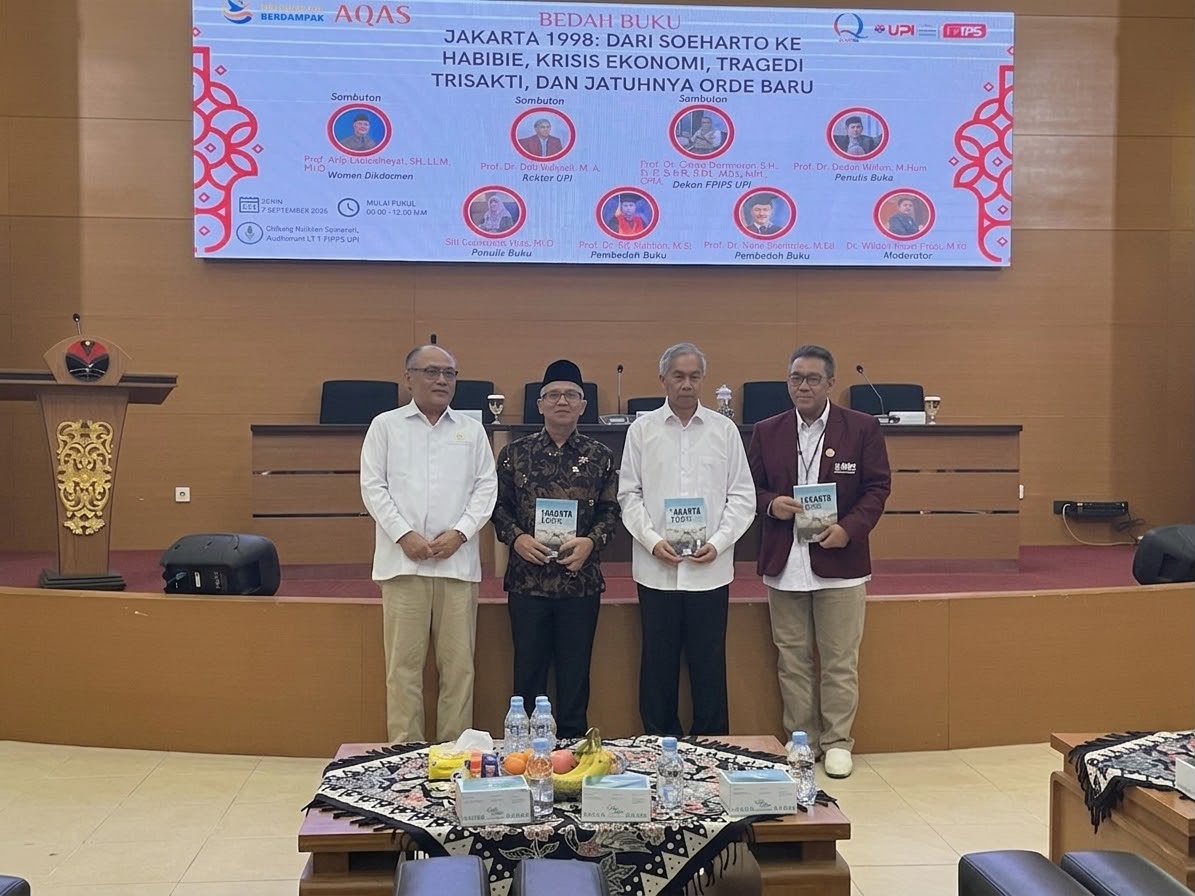
Ministry of Elementary and Secondary Education, September 12, 2026 — Deputy Minister of Elementary and Secondary Education (Wamendikdasmen) Atip Latipulhayat officially opened the book review event "Jakarta 1998: From Soeharto to Habibie (Economic Crisis, Trisakti Tragedy, and the Fall of the New Order)" held by the Faculty of Social Sciences Education (FPIPS), Indonesian University of Education (UPI). The event, which took place at the FPIPS Auditorium of UPI, became an academic space to review one of the important periods in the journey of Indonesian history. Through this activity, the academic community was invited to view the events of 1998 not only as a record of the past, but also as a source of learning for the current generation. The forum also became part of an effort to strengthen academic traditions, reading culture, and critical thinking skills in the university environment. The book "Jakarta 1998" highlights the various dynamics that occurred during the transition from President Suharto to President BJ Habibie. The book discusses several key events, from the economic and monetary crisis, the Trisakti Tragedy, the student movement, to the end of the New Order government. Examining this series of events is crucial because the changes that occurred in 1998 have shaped Indonesia's social, political, and economic life to this day. Therefore, the book review provides a relevant platform for connecting historical knowledge with academic perspectives and the experiences of the generations who experienced it firsthand. In his remarks, Deputy Minister Atip stated that the book "Jakarta 1998" provides a snapshot of the events that occurred during a crucial period in Indonesian history. He noted that the crisis, which initially occurred in Asia, had a significant impact on Indonesia. This was marked by, among other things, the weakening of the rupiah against the US dollar and the emergence of various social movements in response to the economic conditions. "Taiwan was the first country to be affected by the 1998 crisis, and it soon spread to Indonesia. At that time, a movement to promote domestic products emerged, and the dollar-to-rupiah exchange rate soared to its highest level," he said. According to Deputy Minister Atip, understanding history requires the ability to critically read facts and various sources of knowledge. Literacy, in this context, extends beyond the ability to read and understand texts, but also encompasses the ability to place information within its proper historical context. This skill is increasingly important for the younger generation, who did not directly experience the events of 1998. By reading and discussing various sources, students can build a more comprehensive understanding and see the connection between past events and the issues facing the nation today. This view aligns with the importance of higher education as a space for preserving collective memory through dialogue and the exchange of ideas. UPI Rector Didi Sukyadi stated that the events of 1998 need to continue to be documented and made known to the wider public, especially the younger generation. He admitted to witnessing firsthand the dynamics of the student movement at Gedung Sate in 1998 and later receiving news that President Suharto had resigned. He believes the reforms that emerged from this series of events constitute a crucial part of the nation's history, the impact of which is still felt today. Didi added that lessons learned from the history of 1998 are also relevant to Indonesia's current situation. Various global geopolitical challenges can impact the national economy to some extent, requiring the public to develop the ability to critically and contextually understand change. Therefore, book reviews like this are crucial for the academic community, especially students of the Faculty of Psychology and Public Relations (FPIPS) at UPI. This discussion forum is expected to help students connect historical experiences with evolving national challenges. In addition to historical studies, UPI also continues to encourage students to directly engage in addressing educational issues in society. One such initiative is the Gema Jabar (Student Teaching Movement) program, which provides students with the opportunity to practice teaching at schools in West Java that require teaching staff. Didi stated that based on available data, there is a need for approximately 6,000 teaching staff in Bandung City, with shortages primarily in the areas of Physical Education and guidance and counseling. The program, conducted every semester, is a good practice that connects students' academic learning with the real needs of the community. Meanwhile, one of the book's authors, Dadan Wildan, explained that the book Jakarta 1998 was written, among other things, to bridge historical knowledge for the generation born after 1998 and who did not directly experience the various events of that period. He said the choice of the book's title was based on a number of important moments that occurred in 1998, starting from the economic crisis, the Trisakti Tragedy, to the resignation of President Suharto. These events were deemed necessary to be studied and documented in book form so that knowledge about history can still be transmitted to the next generation. "It is important for the generation who did not experience the events of 1998 to know what happened as part of the transmission of knowledge, so that historical awareness can be formed and become a reflection," he said. Another perspective is provided by author Ely Malihah, who highlights the social changes that occurred in 1998. According to her, the crisis that occurred at that time not only impacted the economic sector but also triggered social disintegration marked by various riots, looting, and violence. Amidst these conditions, a collective awareness emerged among students to take action and express their aspirations in various regions, including Bandung, Jakarta, and Surabaya. The Trisakti Tragedy then further intensified public anger until the student movement developed into a significant force driving political change and leading to the end of the New Order government. The various perspectives presented at the event demonstrate that history can be understood through diverse scholarly perspectives. The study of 1998 not only addresses political change but also touches on economic issues, social life, student movements, education, and the changing relationship between society and the state. Thus, books can serve as a gateway for students to understand the complexities of an event while simultaneously developing critical thinking skills. A culture of reading and discussion is becoming increasingly important so that the younger generation not only receives information but is also able to examine, understand, and process it into knowledge. The 1998 Jakarta Book Review was held as a hybrid event and was attended by no fewer than 150 students who filled the UPI FPIPS Auditorium, as well as other online participants. Through this forum, UPI strengthened its role as an academic space that encourages dialogue, reflection, and the exchange of knowledge. The presence of Deputy Minister of Elementary and Secondary Education Atip Latipulhayat also provided support for various higher education efforts to strengthen academic culture and literacy. On this occasion, the Deputy Minister of Elementary and Secondary Education officially opened the event and conveyed congratulations to the book's authors, Dadan Wildan and Siti Komariah. The Jakarta 1998 Book Review not only serves as a forum to revisit a historical period, but also as a momentum to strengthen the intellectual tradition within higher education. Through critical historical reading, students are expected to understand how past decisions and changes shaped the Indonesia of today. This understanding can equip them to face future challenges with stronger knowledge, critical reasoning, and national insight. The spirit of reading, discussing, and reflecting on history is expected to continue to grow as part of the vibrant academic culture within higher education. *** [Author: Meryna / Editor: Denty / Documentation: Ministry of Elementary and Secondary Education Team]
Writer: Kontributor BKHM
Editor: Denty Anugrahmawaty