



Find information about the Ministry of Education and Culture, organizational structure, and regulations.
Profile Information of Kementerian Pendidikan Dasar dan Menengah
Public Information of Kementerian Pendidikan Dasar dan Menengah
Find news, press releases, announcements, and official documentation from Kemendikdasmen
 Home
Profile
Home
Profile
Find information about the Ministry of Education and Culture, organizational structure, and regulations.
About Us
Profile Information of Kementerian Pendidikan Dasar dan Menengah
Profiles of Officials
Public Information
Public Information of Kementerian Pendidikan Dasar dan Menengah
LHKPN Report
Laporan Moch. Abduh
Laporan LHKPN Fajar Riza Ul Haq
Laporan LHKPN Atip Latipulhayat
Laporan LHKPN Suharti
Laporan Abdul Mu'ti
Laporan Faisal Syahrul
Laporan Nunuk Suryani
Laporan Gogot Suharwoto
Laporan Tatang Muttaqin
Laporan Toni Toharudin
Laporan Hafidz Muksin
Laporan Biyanto
Laporan Mariman Darto
Laporan Didik Suhardi
Laporan Muhammad Muchlas Rowi
Laporan Ma'ruf
Laporan Rita Pranawati
Publication
Find news, press releases, announcements, and official documentation from Kemendikdasmen
PPID
The Ministry of Education and Culture Supports the Joint Decree of Seven Ministers on the Use of Digital Technology and AI in Education.


Published on: 12 Maret 2026
Share:
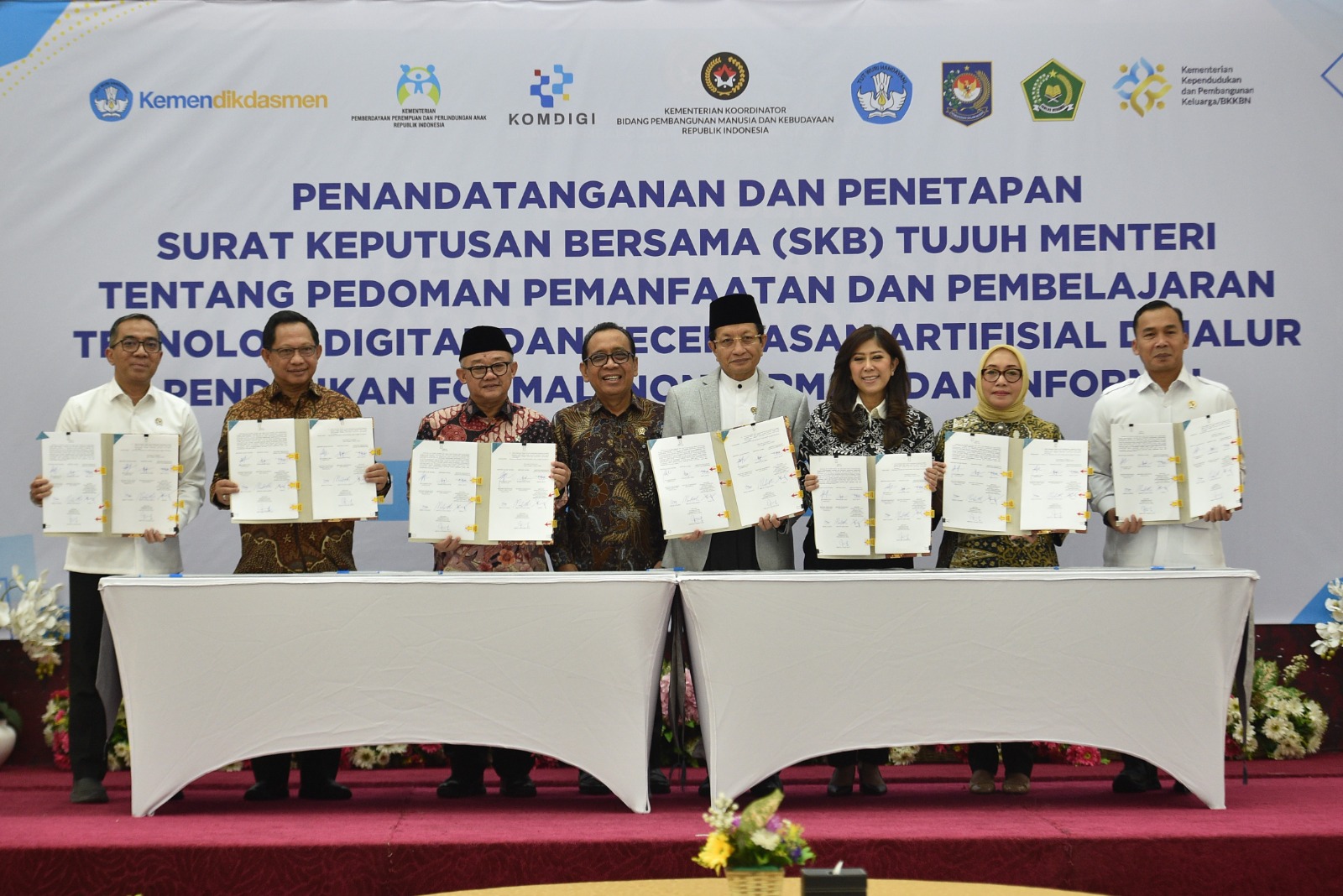
Jakarta, March 12, 2026 – The Ministry of Primary and Secondary Education (Kemendikdasmen) expressed its support for the Joint Decree (SKB) issued by seven ministers concerning Guidelines for the Use and Learning of Digital Technology and Artificial Intelligence in Formal, Non-formal, and Informal Education. The signing of the SKB took place at the Office of the Coordinating Ministry for Human Development and Culture (Kemenko PMK) in Jakarta on Thursday (March 12). The meeting was also attended by Coordinating Minister for Human Development and Culture, Pratikno; Minister of Higher Education, Science, and Technology, Brian Yuliarto; Minister of Home Affairs, Tito Karnavian; Minister of Religious Affairs, Nasaruddin Umar; Minister of Communication and Informatics, Meutya Hafid; Minister of Women's Empowerment and Child Protection, Arifatul Choiri Fauzi; and Minister of Population and Family Development, Wihaji. The Minister of Primary and Secondary Education (Mendikdasmen), Abdul Mu'ti, stated that the Ministry has taken various concrete steps to prepare for the use of digital technology and artificial intelligence in school learning. "Starting in the 2025–2026 academic year, coding and Artificial Intelligence (AI) will be elective subjects for elementary, fifth grade, junior high, and senior high schools," Minister Mu'ti stated. He added that efforts to strengthen teacher capacity are ongoing to ensure optimal implementation of digital technology and artificial intelligence learning in educational institutions. "We have trained 55,000 teachers across Indonesia, at all levels, and have involved 38 percent of educational institutions in Indonesia. Therefore, the program is ongoing, and teacher training is also ongoing. When the number of teachers reaches a certain level, we will take further steps, possibly making coding and AI compulsory subjects," he explained. Furthermore, Minister Mu'ti explained that the coding learning developed in schools is conducted through several approaches to ensure inclusive implementation, tailored to the specific needs of each educational unit. "We use three classifications for coding. First, unplugged coding , second, internet-based coding, and third, game-based coding without the use of computers," she said. According to Minister Mu'ti, this policy is also in line with the government's ongoing educational digitalization program. "And in line with the President's policy on digitalizing learning, where we have distributed more than 288,000 Interactive Flat Panels (IFPs), these devices can also be a tool to support the success and implementation of coding and AI learning in schools across Indonesia," she added. Meanwhile, the Coordinating Minister for Human Development and Culture (Menko PMK), Pratikno, emphasized that the presence of the Joint Decree of the Seven Ministers is a joint government effort to ensure the use of digital technology and artificial intelligence runs wisely and supports the quality of education. Minister Pratikno also stated that digital technology has great potential to support the learning process, but it also requires appropriate regulation to minimize the risk of uncontrolled use. "Our goal is to ensure that children are not dominated by technology, but are able to master technology for good," Minister Pratikno said. He added that the guidelines in this Joint Decree apply to all educational pathways, from early childhood education to higher education, including non-formal and informal education. The use of digital technology and artificial intelligence also needs to be tailored to the age range of students, both in terms of duration of use and the type of content accessed. Through the Joint Decree of the Seven Ministers, the Indonesian government hopes that the use of digital technology and artificial intelligence can strengthen the quality of learning while building a generation that is digitally competent, ethical, and able to use technology responsibly in everyday life.*** (Author: Ririn/Editor: Denty A., Seno H./Photographer: Shaka) Bureau of Communication and Public Relations

Secretariat General
Ministry of Primary and Secondary Education
Website: kemendikdasmen.go.id
X: x.com/Kemdikdasmen
Instagram: instagram.com/kemendikdasmen
Facebook: facebook.com/kemendikdasmen
YouTube: Ministry of Education and Culture
Questions and Complaints: ult.kemendikdasmen.go.id
Press Release from the Ministry of Primary and Secondary Education: kemendikdasmen.go.id/pencarian/siaran-pers
#QualityEducationforAll
#MinistryOfEducationAndEducationFriendly
Attachment
Source: Siaran Pers Kementerian Pendidikan Dasar dan Menengah Nomor: 207/sipers/A6/III/2026
Writer: Ririn Ramandani
Editor: Denty Anugrahmawaty
 PaudDikdasmen
Pendidikan Vokasi
Badan Bahasa
BKPDM
Guru Sekolah Kejuruan
Sekolah Kejuruan
Dinas Pendidikan
Ruang Murid
Ruang GTK
Ruang Sekolah
Ruang Orang Tua
Ruang Pemerintah
Ruang Mitra
Ruang Publik
Ruang Bahasa
GTK
Itjen
Vokasi
Sekjen
Murid Kejuruan
Guru PAUD
Guru Dikdasmen
Sekolah PAUD
Sekolah Dikdasmen
Murid PAUD
Murid Dikdasmen
Mitra Dikdasmen
Orang Tua
Sastrawan
Pegiat Literasi
Strengthening Character Education
PaudDikdasmen
Pendidikan Vokasi
Badan Bahasa
BKPDM
Guru Sekolah Kejuruan
Sekolah Kejuruan
Dinas Pendidikan
Ruang Murid
Ruang GTK
Ruang Sekolah
Ruang Orang Tua
Ruang Pemerintah
Ruang Mitra
Ruang Publik
Ruang Bahasa
GTK
Itjen
Vokasi
Sekjen
Murid Kejuruan
Guru PAUD
Guru Dikdasmen
Sekolah PAUD
Sekolah Dikdasmen
Murid PAUD
Murid Dikdasmen
Mitra Dikdasmen
Orang Tua
Sastrawan
Pegiat Literasi
Strengthening Character Education