



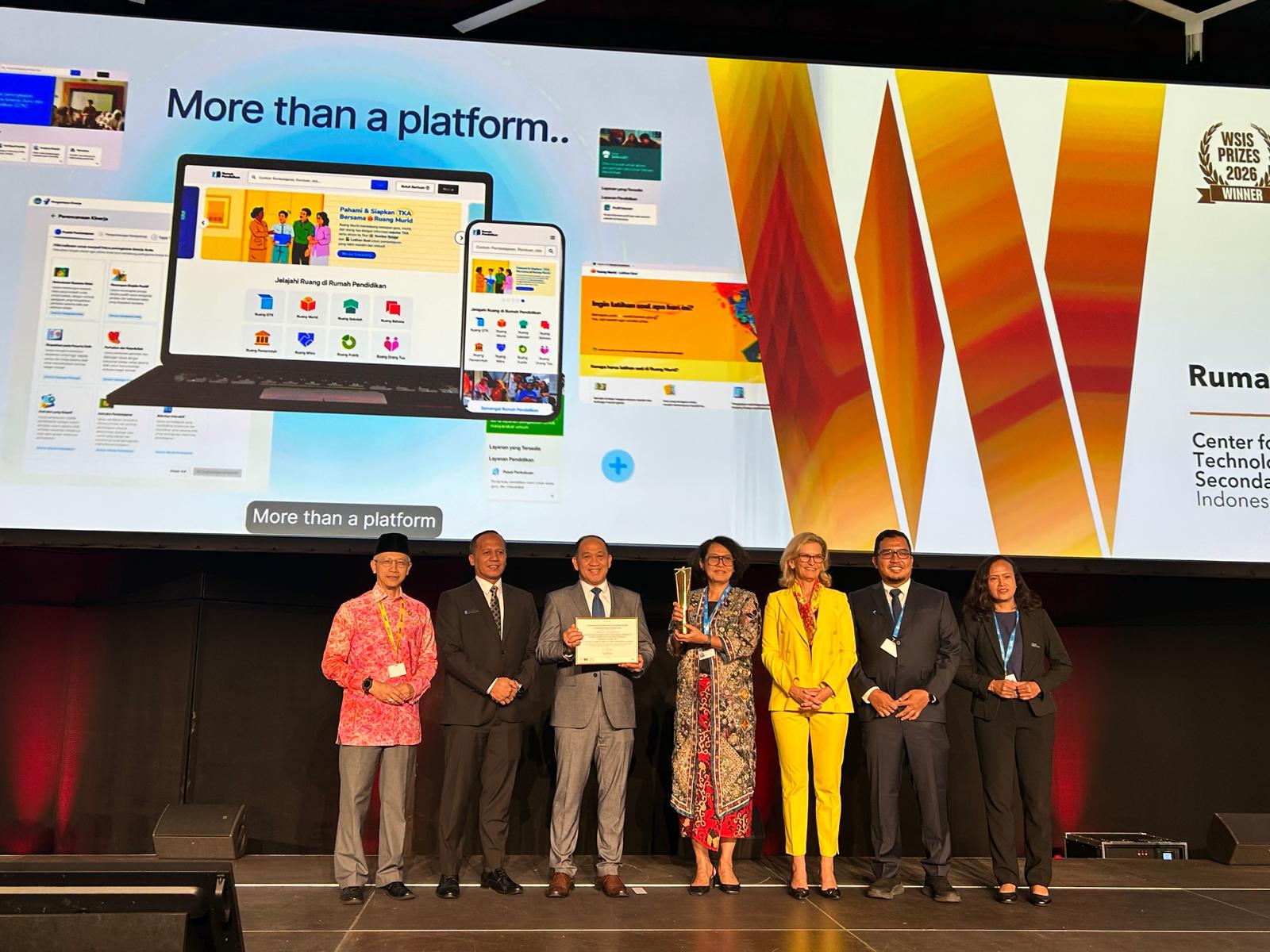
Geneva, Switzerland, Ministry of Primary and Secondary Education --- When Rumah Pendidikan was announced as the Winner of the 2026 WSIS Prizes in the e-Government category, Indonesia did not just take home an international award. More than that, Indonesia made new history. For the first time since the WSIS Prizes were organized by the International Telecommunication Union (ITU) in 2012, Indonesia succeeded in achieving the Winner title in the e-Government category through a digital innovation created by Indonesian children developed by the Ministry of Primary and Secondary Education (Kemendikdasmen).
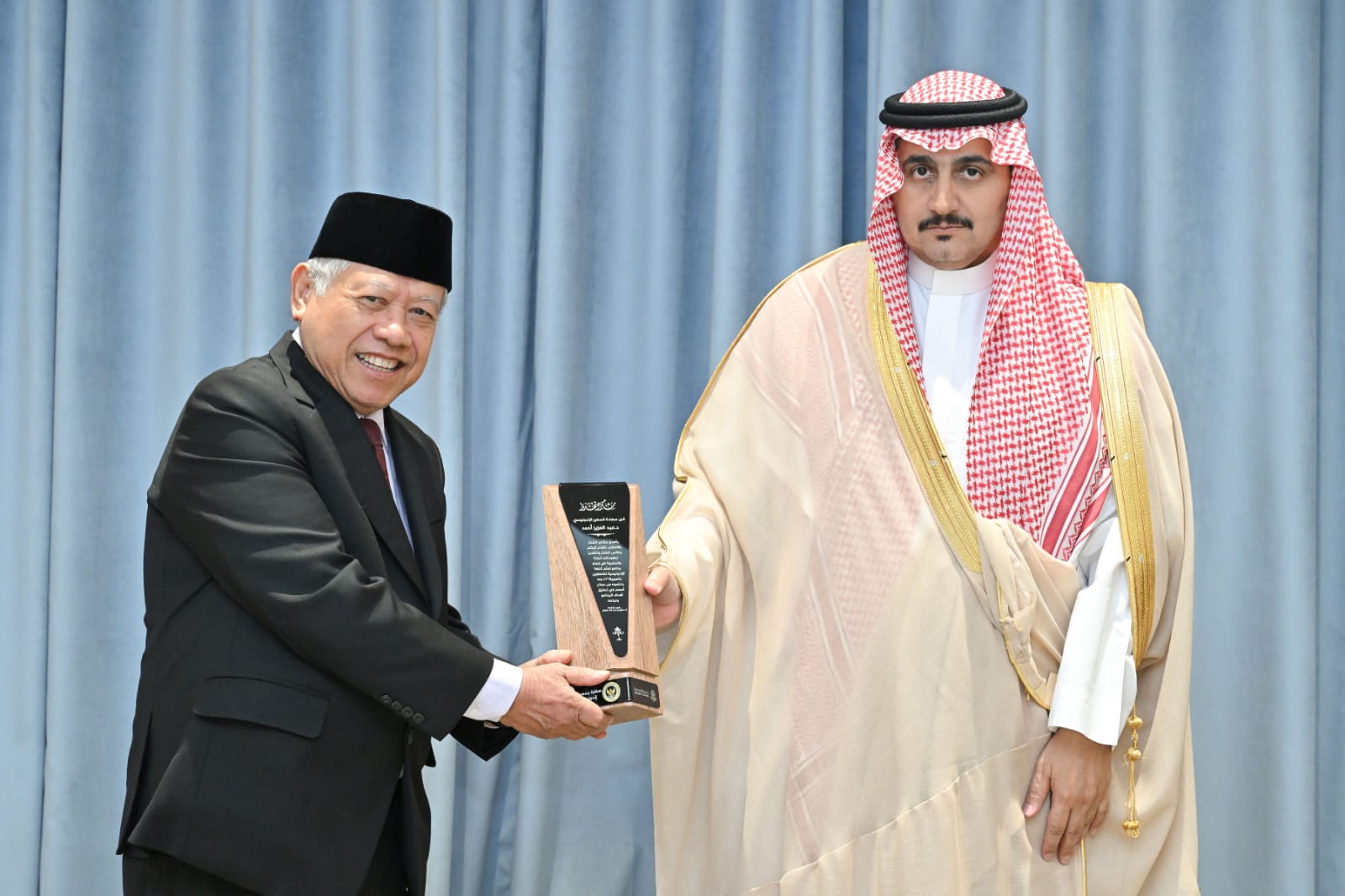
The award was received by the Secretary General of the Ministry of Primary and Secondary Education, Suharti, who represented the Indonesian Minister of Primary and Secondary Education in Geneva, Switzerland, Thursday (9/7).
"This award is the fruit of President Prabowo Subianto's vision to expand access to education through technology, the leadership of the Minister of Primary and Secondary Education, Prof. Abdul Mu'ti, and the dedication of all education stakeholders, especially the ranks of the Ministry of Elementary and Secondary Education and the Rumah Pendidikan team. This international recognition further strengthens our commitment to continue providing quality education that is accessible to every Indonesian child," said Suharti.
This international award was won after competing against 1,596 digital innovations from 122 countries. From all the submitted innovations, an international jury selected 360 nominees. Furthermore, based on more than 2.2 million public votes, 90 Champion Projects were selected. In the final stage, a jury consisting of experts selected 18 Winners and 72 Champions across the 18 WSIS Action Lines categories.
This achievement marks a significant milestone in the digital transformation of Indonesian education and demonstrates that Indonesian public service innovation is capable of competing and gaining recognition at the global level.
The WSIS Prizes are part of the implementation of the World Summit on the Information Society (WSIS), organized by the ITU in collaboration with various United Nations (UN) agencies. Each year, the awards recognize the world's best projects leveraging information and communications technology to support sustainable development across 18 WSIS Action Lines.
Among all these categories, Action Line C7: e-Government is one of the most prestigious categories because it assesses how the government utilizes digital technology to provide public services that are more effective, inclusive, and have a direct impact on the community.
Since the WSIS Prizes were first held in 2012, the Action Line C7: e-Government category has been won by digital innovations from India, Bangladesh, Saudi Arabia, Turkey, Russia, China, Azerbaijan, the United Arab Emirates, and Indonesia.
For over a decade, the awards have been dominated by public service innovations such as pension systems, government administration services, e-courts, land administration, licensing, and artificial intelligence-based government services. It wasn't until 2026 that Indonesia made history with Rumah Pendidikan, the first Indonesian winner in this category.

WSIS Prizes Action Line C7 Winner Trail: e-Government (2012–2026)
Year | Country | Innovation Project |
2012 | India | NICT – Samadhan Project |
2013 | India | Project SAKSHAM |
2014 | Bangladesh | Services @ Citizens' Doorsteps |
2015 | Saudi Arabia | The System of Committees and Councils |
2016 | Turkish | e-National Judicial System |
2017 | Russian Federation | Rendering of State and Municipal Services in Electronic Format |
2018 | China | Targeted Poverty Alleviation System (TPAS) |
2019 | Saudi Arabia | Licenses Portal |
2020 | India | Sabooj Sathi Online 3.0 |
2021 | Azerbaijan | Citizens' Electronic Appeals System |
2022 | Bangladesh | Digital Land Tax |
2023 | India | AuditOnline |
2024 | Azerbaijan | MyGov |
2025 | United Arab Emirates | TAMM AI Assistant |
2026 | Indonesia | House of Education |
Indonesia actually demonstrated its contribution at the 2021 WSIS Prizes through the Jakarta Kini (JAKI) Superaplikasi, which earned the Champion title in the Action Line C7: e-Government category. In official ITU terminology, Champion does not mean runner-up , but rather a project that successfully passed the international selection process and entered the ranks of the best projects in its category. Meanwhile, Winner is the project ultimately selected as the main winner.
Therefore, the success of the Education House in 2026 holds special significance. For the first time, Indonesia has achieved the top ranking in the e-Government category since the WSIS Prizes were first held.
On a separate occasion, the Minister of Primary and Secondary Education (Mendikdasmen) Abdul Mu'ti explained that since its launch in January 2025, Rumah Pendidikan has become part of the educational transformation from schooling to learning , namely learning that is no longer limited to the classroom, but can take place anytime and anywhere through various digital education services.
He also explained that Rumah Pendidikan is present to strengthen the digital learning ecosystem as part of the implementation of President Prabowo Subianto's Fast Best Results Program (PHTC) in accordance with Presidential Instruction Number 7 of 2025. To date, 288,865 educational units have received Interactive Flat Panels (IFP) which serve as supporting facilities for accessing Rumah Pendidikan services.
"This achievement is an important milestone because for the first time since the WSIS Prizes were organized by ITU in 2012, Indonesia has succeeded in winning the Winner title in the e-Government category through Rumah Pendidikan, a digital innovation created by the nation's children developed by the Ministry of Primary and Secondary Education," explained Minister of Primary and Secondary Education Abdul Mu'ti.
To date, the Rumah Pendidikan ecosystem has integrated 66 educational services, utilized by over 6.9 million users and recorded over 67 million visits. Twenty-one partners provide over 3,000 digital learning materials through Ruang GTK and Ruang Murid, while Ruang Murid itself has been visited more than 37.7 million times by approximately 3.6 million users, with free access to 4,843 learning resources.
To support data-driven education governance, 339,000 educational units, along with local governments in 513 districts/cities, have utilized the Education Report through Rumah Pendidikan. This platform has also partnered with more than 50 strategic partners to strengthen collaboration across the education ecosystem.
The use of Rumah Pendidikan (Education House) continues to expand, including by 104,814 teachers in the 3T (third-to-third) regions, or approximately 54.6 percent of the total teachers in those regions. Through the Learning Management System (LMS), 23,600 training classes are available, including for priority programs in Deep Learning, Coding, and Artificial Intelligence (AI). Furthermore, 1,450 Digital Warrior Teachers (GPD) have conducted 2,700 outreach activities, increasing the capacity of more than 137,000 teachers in utilizing technology for learning.
Deputy Permanent Representative of the Republic of Indonesia/Ambassador of the Permanent Mission to Geneva, Achsanul Habib, who was also present at the WSIS Prizes 2026 award ceremony, stated that the Permanent Mission of the Republic of Indonesia (PTRI) to Geneva will continue to support and champion Indonesia's interests in various multilateral forums in Geneva, which is one of the world's centers of digital diplomacy.
"Indonesia's success in winning the WSIS Prizes 2026 Winner title in the Action Line C7: e-Government category for the first time since the event was held in 2012 is a proud achievement for the world of national education. This recognition shows that Indonesian innovation is able to compete at the global level and is a source of pride for teachers, students, parents, and all Indonesian people. This achievement confirms that technology can be part of the solution to expand access, increase equal opportunities, and provide more inclusive and quality education for all," said Habib.
The journeys of the winners in this category also demonstrate how the concept of e-Government continues to evolve. Rumah Pendidikan presents a distinct approach. Rumah Pendidikan not only digitizes government services but also builds an integrated digital education ecosystem that connects teachers, students, parents, schools, the government, and various partners on a single platform. This approach broadens the meaning of e-Government, from simply digitizing administrative services to transforming public services centered on community needs.
More importantly, Rumah Pendidikan was born from the belief that a child's place of residence should not determine the quality of education they receive. In an archipelago of over 17,000 islands, the challenge of educational equity cannot be solved through physical development alone. Digital transformation serves as a bridge connecting learning spaces across Indonesia.
Through the Education House, teachers gain access to competency development, learning resources, and integrated educational services. Parents are more easily involved in their children's learning process. Schools receive simpler and more efficient public services. Technology is used not to replace teachers, but to strengthen their role as centers of learning.
This success also demonstrates the maturation of Indonesia's digital innovation. While a decade ago, Indonesia was still learning from various global best practices, it is now beginning to contribute by presenting digital transformation models relevant to developing countries facing similar geographic challenges.
This international recognition also strengthens Indonesia's commitment to utilizing digital transformation to improve the quality of education and support the achievement of the Sustainable Development Goals (SDGs), particularly SDG 4 on Quality Education.
Behind this award lies a long collaborative effort. It begins with President Prabowo Subianto's vision to expand access to education through technology, the leadership of Minister of Primary and Secondary Education Abdul Mu'ti in driving the digital transformation of education, and the dedication of teachers, education personnel, technology developers, local governments, partners, and the entire Ministry of Primary and Secondary Education team who created the Rumah Pendidikan (Education House).
Ultimately, this award isn't the finish line. It's the beginning of a greater responsibility. The measure of digital transformation success isn't the amount of technology developed, but rather the increasing number of Indonesian children receiving better education opportunities.
Rumah Pendidikan has led Indonesia to become the Winner of the 2026 WSIS Prizes. The next challenge is to ensure that every digital innovation truly brings tangible benefits to every teacher, every school, and every child in Indonesia—wherever they are. ( Yudhistira Nugraha)